Matcha vs Sencha vs Gyokuro: Japanese Green Teas Compared
Key Takeaways
- Same plant, three different decisions. Matcha, sencha, and gyokuro all come from Camellia sinensis. What separates them is how much sunlight the leaves got and whether you drink the leaf or just its infusion.
- Shading raises amino acids and lowers catechins. In a 2025 analysis of Japanese green teas, gyokuro leaf contained about 30.8 mg/g of theanine versus 18.9 mg/g in standard sencha — while sencha carried more EGCG (62.2 vs 53.3 mg/g).[1]
- Matcha is the only one where you swallow the leaf. A single 1-minute sencha infusion extracts roughly a quarter of the leaf's EGCG, based on the same dataset — the rest stays in the leaves you throw away.
- Gyokuro is the umami extreme, sencha the everyday catechin source, matcha the whole-leaf option. None is "healthiest"; they're different trade-offs between taste, caffeine, and what actually reaches your cup.
- Brewing temperature moves the numbers as much as the tea does. Cold water pulls theanine and arginine more readily than caffeine and EGCG.[1]
Matcha, sencha, and gyokuro aren't three plants. They're three answers to the same question: how do you want to treat a tea leaf?
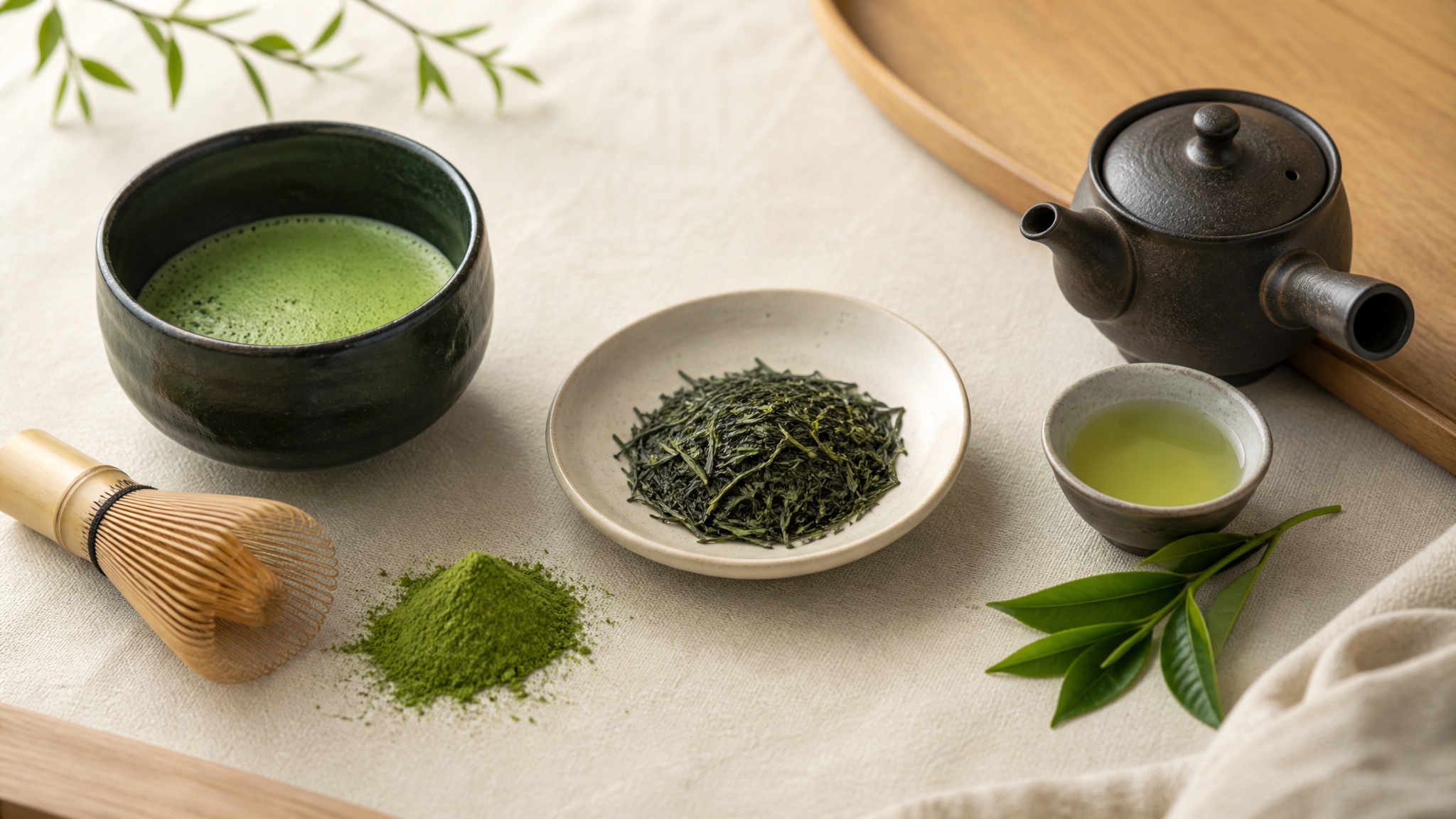
Sencha is grown in full sun and steeped. Gyokuro is shaded for about three weeks, then steeped gently in cool water. Matcha starts as shaded leaf too (called tencha), but it's de-stemmed, de-veined, stone-ground, and consumed whole. Those three choices produce measurably different chemistry — and the differences are bigger than most comparison charts suggest.
What shading actually does to the leaf
Theanine is synthesized in the tea plant's roots and moved up to new shoots, where sunlight drives its conversion into catechins — the astringent compounds including EGCG. Block the light and you interrupt that conversion, so theanine accumulates and catechins don't.[1][4]
This isn't folklore. A 2022 study that shaded matcha-destined tea plants and sequenced their transcriptomes found theanine and caffeine contents rose under shade while epigallocatechin and epicatechin fell, tracking down-regulation of catechin biosynthesis genes.[4] A separate trial growing gyokuro-styled tea in Australia found that only very intense shading — around 99% of visible light — produced the theanine and caffeine shifts that define the style commercially.[5] Partial shade cloth doesn't get you gyokuro.
Shading is a deliberate trade: more umami and theanine, fewer catechins. You cannot maximize both in the same leaf.
The numbers, side by side
The cleanest recent dataset comes from a 2025 analysis in Foods, which measured amino acids, caffeine, and individual catechins in eight Japanese green teas — then brewed each one the way it's traditionally served and measured the liquid too.[1]
Here's what's in the dry leaf, per gram:
| Compound (mg per g of leaf) | Gyokuro | Standard sencha | Superior sencha |
|---|---|---|---|
| Theanine | 30.84 | 18.91 | 20.37 |
| Arginine | 9.72 | 4.72 | 5.63 |
| Caffeine | 35.41 | 24.70 | 31.01 |
| EGCG | 53.31 | 62.16 | 67.45 |
Notice that gyokuro leads on theanine, arginine, and caffeine — shading raises caffeine too, which surprises people who assume "gentler tea, less caffeine." Sencha leads on EGCG.
Matcha isn't in that dataset, but it's been measured elsewhere. A 2023 survey of 11 matcha products found L-theanine ranging from 9.3 to 28.5 mg/g and caffeine from 1.72% to 4.41% by weight.[2] At the standard 2-gram serving (about 1 teaspoon), that works out to roughly 19–57 mg of theanine and 34–88 mg of caffeine — a wide band that reflects real differences in shading, harvest timing, and grade.
Grade matters more than marketing implies. A 2025 multianalytical comparison of matcha grades found ceremonial-grade samples contained roughly 2.8 times the theanine and 1.6 times the EGCG of a food-grade sample in the same extract analysis.[3] If a matcha tastes harsh and thin, that's usually a late-harvest, lightly shaded leaf — not a brewing error.
Gyokuro is the theanine and caffeine champion in leaf form; sencha carries the most EGCG; matcha's numbers swing widely by grade, so the tin you buy matters more than the category.
Steeping throws most of the catechins away
This is the part comparison charts usually skip. With sencha and gyokuro, you're drinking an extract — and extraction is inefficient and selective.
Using the brewed-infusion figures from the same 2025 analysis, we can calculate how much of each compound actually made it into the cup.[1] Standard sencha brewed at 90°C for one minute (6 g in 260 mL) delivered about 50% of the leaf's theanine, 58% of its caffeine — but only 27% of its EGCG. Gyokuro brewed the traditional way (10 g in 60 mL at 60°C for two minutes) gave up 55% of its theanine and just 13% of its EGCG.
Two caveats: these are single first infusions, and both teas are normally re-steeped, which pulls out more. And the numbers are our arithmetic from the study's reported leaf and infusion values, not a figure the authors published as an extraction rate.
Matcha has no extraction step. You whisk powdered leaf into suspension and drink all of it — catechins, theanine, caffeine, fiber, chlorophyll. That's the entire structural argument for matcha, and it's a real one.
Sencha leaf may contain more EGCG than gyokuro, but a first steep releases only about a quarter of it. Matcha's advantage isn't a richer leaf — it's that nothing gets discarded.
What about the calm-focus effect?
The theanine-plus-caffeine combination is the most commonly cited reason to choose green tea over coffee. The evidence is real but more modest than the internet suggests.
A 2025 systematic review and meta-analysis in Nutrition Reviews pooled RCTs in healthy adults and found small-to-moderate differences favoring theanine plus caffeine over placebo on outcomes like attention-switching accuracy (SMD 0.33; 95% CI 0.13, 0.54) and digit vigilance accuracy (SMD 0.20; 95% CI 0.02, 0.38) in the second hour after intake.[6] The authors were explicit that confidence intervals often left the direction and size of the effect uncertain, and that more trials using actual tea — rather than isolated compounds at supra-dietary doses — are needed.
Practically: gyokuro and good ceremonial matcha are the highest-theanine options, and a 2-gram matcha serving or a small gyokuro cup lands in a plausible dietary range. That is not the same as reproducing the 100–400 mg isolated theanine doses used in many trials. Anyone claiming a bowl of matcha equals a study dose is overselling it.
Temperature is a lever you control
The 2025 Foods analysis also tracked how brewing conditions shift the ratio of stimulating compounds (caffeine, EGCG) to calming ones (theanine, arginine). Deep-steamed sencha brewed at 90°C had a caffeine-and-EGCG-to-theanine-and-arginine molar ratio of 1.73; cold-brewed at 5°C, the same tea dropped to about 1.1 — meaning proportionally less caffeine and EGCG relative to amino acids.[1] Cold water is slow, though: concentrations barely moved for the first 6 hours and only doubled after 12.
That's why gyokuro is traditionally brewed at 50–60°C. Cooler water flatters the umami and holds back bitterness. Sencha at 70–80°C keeps astringency in check. Matcha wants roughly 70–80°C water and a whisk — boiling water scorches it into bitterness.
Which should you actually drink?
Choose sencha if you want an everyday cup, the most catechins per dollar, and a brisk, grassy, slightly astringent profile. It's the tea most people in Japan drink daily, and it's forgiving.
Choose gyokuro if you're chasing umami and don't mind the ritual — small leaf-to-water ratio, cool water, tiny concentrated servings. It's expensive, it's intense, and it carries more caffeine per gram than either alternative.
Choose matcha if you want the whole leaf, a consistent serving you can measure, and a base that works in a bowl or a latte. It's also the only one of the three where you control the dose precisely, because you weigh the powder instead of guessing at extraction.
Most people who drink all three end up rotating: sencha as the daily driver, matcha in the morning when focus matters, gyokuro on a slow weekend afternoon.
If you want to start with the whole-leaf option, our 1.06oz ceremonial-grade tin holds about 15 servings at the 2-gram standard — enough to learn whether you actually prefer matcha's texture to a steeped cup before committing to more.
The research above reflects findings from independent studies and clinical trials, not claims about any specific product. Compound levels vary between harvests and producers, including ours.
These statements have not been evaluated by the FDA. This product is not intended to diagnose, treat, cure, or prevent any disease.
References
- Unno K, Ikka T, Yamashita H, Kameoka Y, et al. Stress-relieving effects of Japanese green tea: evaluation using the molar ratio of caffeine and epigallocatechin gallate to theanine and arginine as an indicator. Foods. 2025;14(1):103. doi:10.3390/foods14010103
- Luo Y, Zhang Y, Qu F, Qian W, et al. Variations of main quality components of matcha from different regions in the Chinese market. Frontiers in Nutrition. 2023;10:1153983. doi:10.3389/fnut.2023.1153983
- Toniolo C, Patriarca A, De Vita D, Santi L, et al. A comparative multianalytical approach to the characterization of different grades of matcha tea (Camellia sinensis (L.) Kuntze). Plants. 2025;14(11):1631. doi:10.3390/plants14111631
- Chen X, Ye K, Xu Y, Zhao Y, et al. Effect of shading on the morphological, physiological, and biochemical characteristics as well as the transcriptome of matcha green tea. International Journal of Molecular Sciences. 2022;23(22):14169. doi:10.3390/ijms232214169
- Krahe J, Krahe MA. Optimizing the quality and commercial value of gyokuro-styled green tea grown in Australia. Beverages. 2022;8(2):22. doi:10.3390/beverages8020022
- Payne ER, Aceves-Martins M, Dubost J, Greyling A, de Roos B. Effects of tea (Camellia sinensis) or its bioactive compounds L-theanine or L-theanine plus caffeine on cognition, sleep, and mood in healthy participants: a systematic review and meta-analysis of randomized controlled trials. Nutrition Reviews. 2025;83(11):1873-1891. doi:10.1093/nutrit/nuaf054

Written by Nippon Matcha