Key Takeaways
- Sift the matcha into the flour, never into the wet batter. Matcha clumps the instant it meets liquid, and you can't whisk those lumps out of a thick banana batter.
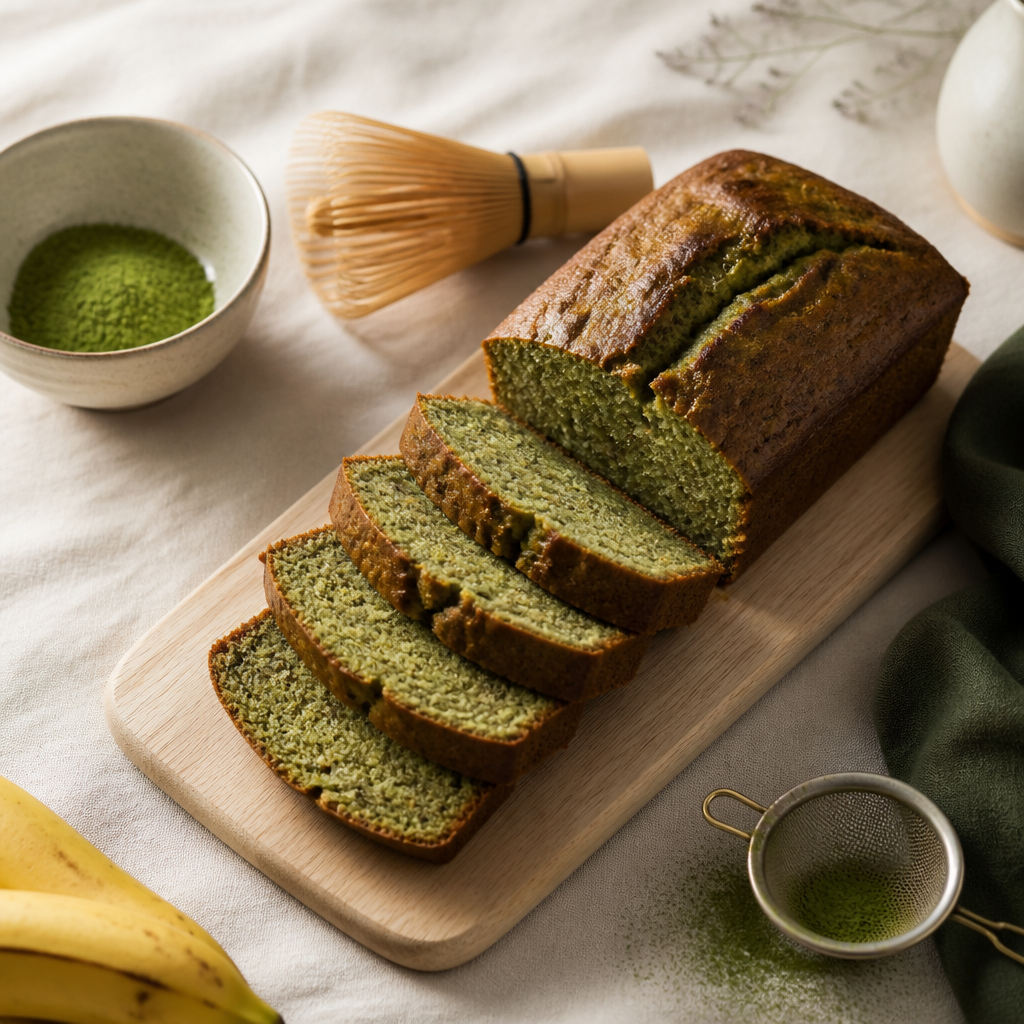
- Expect sage green, not neon green. Heat and the natural acidity of ripe bananas convert chlorophyll to olive-toned pheophytin. Any recipe promising a vivid green crumb is either using food coloring or lying.
- Very ripe bananas do the heavy lifting. Black-spotted, almost unpleasant-looking bananas give you moisture and sweetness so the matcha doesn't have to fight added sugar.
- 2 tablespoons of matcha is the sweet spot. Less and it tastes vaguely grassy; more and the astringency overwhelms the banana.
- This loaf has caffeine. Roughly 35–40mg per slice in a 10-slice loaf — about a cup of black tea. Worth knowing before the after-dinner slice.
Most matcha banana bread recipes fail in the same two places: the matcha goes in as lumps, and the finished loaf comes out the color of an old army jacket. Both problems are fixable, and neither requires anything exotic.
Banana bread is actually a forgiving home for matcha. The bananas bring sweetness and moisture, which softens matcha's astringency, and the dense crumb carries the flavor better than a light cake would. What you get is a loaf that tastes like banana bread with an earthy, slightly tannic backbone — closer to a good green tea cake than a novelty bake.
Why matcha turns dull in the oven (and what to do about it)
The green in matcha comes from chlorophyll, which the shade-growing process concentrates in the leaf [1]. Chlorophyll is stable in a bowl of whisked matcha and unstable almost everywhere else. Heat plus acid converts it to pheophytin, a compound that reads olive-brown rather than green. Ripe bananas are mildly acidic, and a loaf pan spends an hour at 350°F. Both work against you.
You can slow it down, but you can't stop it:
- Skip acidic dairy. Whole milk instead of buttermilk, sour cream, or yogurt keeps the batter closer to neutral.
- Don't over-bake. Pull the loaf as soon as a skewer comes out with moist crumbs — every extra five minutes costs you color.
- Use a light-colored metal pan. Dark pans run hotter at the edges and brown the crust faster.
A muted, sage-toned green crumb is the honest result of baking real matcha. Treat it as the target, not a failure.
Ingredients
Dry:
- 1¾ cups (220g) all-purpose flour
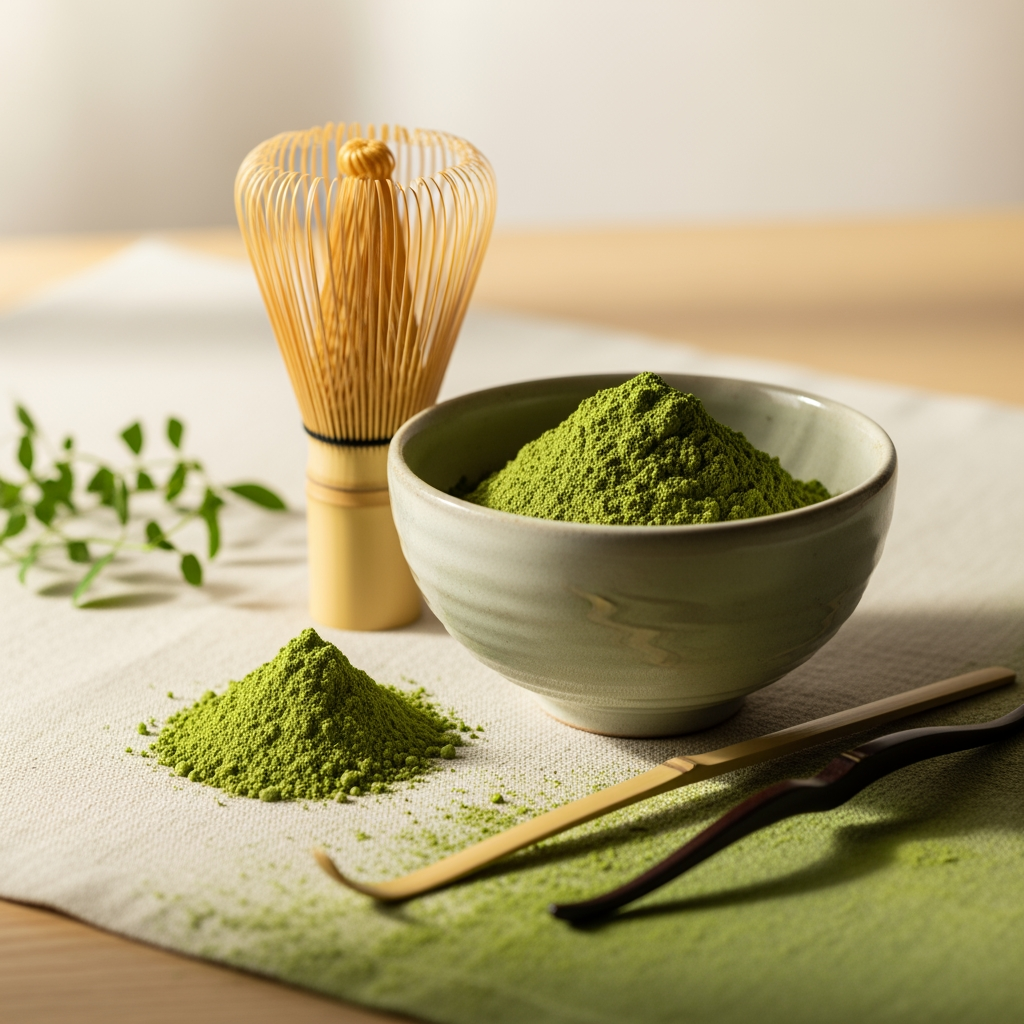
- 2 tablespoons (about 12g) matcha powder, sifted
- 1 teaspoon baking soda
- ½ teaspoon baking powder
- ½ teaspoon fine sea salt
Wet:
- 3 very ripe bananas, mashed (about 1¼ cups)
- ½ cup (113g) unsalted butter, melted and cooled
- ¾ cup (150g) granulated sugar
- 2 large eggs, room temperature
- 3 tablespoons whole milk
- 1½ teaspoons vanilla extract
Optional: ½ cup white chocolate chips or roughly chopped pistachios. Both play well with matcha; adding both is too much.
Steps
1. Prep. Heat the oven to 350°F (175°C). Grease and line a 8½ x 4½-inch loaf pan with parchment, leaving an overhang on the long sides so you can lift the loaf out later.
2. Sift the matcha with the flour. Push the matcha, flour, baking soda, baking powder, and salt through a fine-mesh strainer into a bowl, then whisk for 20 seconds. This is the single most important step in the recipe. Matcha particles are only about 5–10 microns across and hydrate instantly, forming a waterproof skin around dry clumps. Dispersed in flour first, they never get the chance.
3. Mash the bananas properly. A fork is fine, but go further than you think — you want a loose purée with only a few small lumps. Large banana chunks create wet pockets that steam instead of bake.
4. Combine the wet ingredients. Whisk the melted butter and sugar together, then add the eggs one at a time, followed by the milk and vanilla. Stir in the mashed bananas last.
5. Fold, don't beat. Add the dry mixture to the wet in two additions, folding with a spatula until you no longer see dry flour. Overmixing develops gluten and gives you a tough, tunnelled loaf. A few streaks at the end are fine; they'll disappear.
6. Bake 50–60 minutes. Tent loosely with foil at the 35-minute mark if the top is browning fast. Test at 50 minutes: a skewer in the center should come out with moist crumbs, not wet batter.
7. Cool before slicing. Ten minutes in the pan, then lift it out and cool on a rack for at least 45 minutes. Cutting hot banana bread compresses the crumb into paste. This is the hard part.
The one matcha tip that matters most
Use matcha you'd actually be willing to drink. Ceremonial-grade matcha is smoother and less astringent, and in a bake with only 12g of matcha across ten slices, that difference is noticeable — cheap, dull-green culinary powder tastes bitter and slightly fishy once the sugar is in play. You don't need the most expensive tin on the shelf, but bargain-bin matcha will make bargain-bin banana bread.
Storage
Wrapped tightly at room temperature, the loaf keeps for 3 days and is arguably better on day two once the flavors settle. Refrigeration dries it out. For longer storage, slice it first and freeze the slices in a sealed bag for up to 3 months — they toast straight from frozen.
A note on caffeine and what baking does to matcha
Twelve grams of matcha spread across a ten-slice loaf works out to roughly 1.2g per slice. Using the standard figure of about 35mg of caffeine per gram of matcha (a 2g serving, or one teaspoon, delivers roughly 70mg), that's around 35–40mg per slice — comparable to a cup of black tea [1]. Not dramatic, but not nothing if you're sensitive or slicing into it at 9pm.
Matcha's catechins, particularly EGCG, are the compounds most often studied for antioxidant activity, and reviews of matcha's composition consistently note their concentration in the whole leaf [1][3]. What's less often mentioned is that these compounds are heat-sensitive: laboratory work on EGCG in aqueous systems found meaningful degradation and epimerization at elevated temperatures [4]. Research on matcha's effects in humans is generally conducted with prepared tea, not baked goods, and remains limited and mixed [2].
Bake matcha because it tastes good. Drink matcha if you're interested in what the research on catechins suggests.
The research above reflects findings from independent studies, not claims about any specific product.
If you want matcha that works in both the bowl and the loaf pan, our 1.06oz ceremonial-grade tin is a reasonable starting point — enough for a loaf plus a week of morning bowls.
These statements have not been evaluated by the FDA. This product is not intended to diagnose, treat, cure, or prevent any disease.
Frequently Asked Questions
Why did my matcha banana bread turn brown instead of green?
Almost always heat and acidity. Chlorophyll converts to olive-brown pheophytin when it's heated in a mildly acidic batter, and ripe bananas are mildly acidic. Using whole milk instead of buttermilk or yogurt, avoiding a dark metal pan, and pulling the loaf as soon as it tests done will all preserve more color. Even done perfectly, expect a soft sage green rather than a bright one.
Can I use culinary-grade matcha for banana bread?
You can, and it costs less. The trade-off is flavor: culinary grade is more astringent and duller in color, which shows up as bitterness against the sweetness of banana. If culinary grade is what you have, reduce the matcha to 1½ tablespoons and add an extra tablespoon of sugar.
How much matcha should I use in banana bread?
Two tablespoons (about 12g) for a standard 8½ x 4½-inch loaf. At one tablespoon the matcha reads as a faint grassy note, and beyond three tablespoons the astringency dominates and the crumb dries out because matcha powder absorbs moisture.
Does matcha banana bread contain caffeine?
Yes. Twelve grams of matcha across a ten-slice loaf gives roughly 35–40mg of caffeine per slice, using the standard estimate of about 35mg per gram of matcha. That's roughly a cup of black tea per slice — worth keeping in mind for children or for late-evening servings.
Can I make this recipe gluten-free or dairy-free?
Both work with straightforward swaps. Replace the flour with a 1:1 gluten-free baking blend containing xanthan gum, and expect a slightly denser crumb. For dairy-free, use melted refined coconut oil in place of butter and any unsweetened plant milk in place of whole milk — oat milk is closest in texture.
References
- Kochman J, Jakubczyk K, Antoniewicz J, Mruk H, Janda K. Health Benefits and Chemical Composition of Matcha Green Tea: A Review. Molecules. 2020;26(1):85. doi:10.3390/molecules26010085
- Sokary S, Al-Asmakh M, Zakaria Z, Bawadi H. The therapeutic potential of matcha tea: A critical review on human and animal studies. Current Research in Food Science. 2023;6:100396. doi:10.1016/j.crfs.2022.100396
- Jakubczyk K, Kochman J, Kwiatkowska A, et al. Antioxidant Properties and Nutritional Composition of Matcha Green Tea. Foods. 2020;9(4):483. doi:10.3390/foods9040483
- Wang R, Zhou W, Jiang X. Reaction kinetics of degradation and epimerization of epigallocatechin gallate (EGCG) in aqueous system over a wide temperature range. Journal of Agricultural and Food Chemistry. 2008;56(8):2694–2701. doi:10.1021/jf0730338 (Cited despite its age — it remains the primary kinetics reference for EGCG thermal degradation.)