Matcha and Sleep: Can an Afternoon Bowl Affect Your Night?
Key Takeaways
- Caffeine timing matters more than most people think. A 2023 meta-analysis of 37 trials found that caffeine cut total sleep time by roughly 45 minutes on average — and that the later the dose, the larger the disruption.[1]
- A 2g serving of matcha delivers roughly 60–70mg of caffeine — about two-thirds of a standard cup of coffee — plus 40–50mg of L-theanine, an amino acid that doesn't exist in coffee.[2][3]
- Matcha-specific research is reassuring, but limited. In a 4-week trial, daily matcha (71.5mg caffeine) didn't measurably change objective sleep EEG in adults aged 27–64, though participants reported slightly better sleep satisfaction.[2]
- Why you feel it at night depends on metabolism. Caffeine half-life ranges from roughly 2 to 10 hours across healthy adults, largely due to genetic differences in the liver enzyme that clears it.[1]
- Practical cutoff: most evidence points to finishing caffeine at least 8–9 hours before bed. For an 11pm bedtime, that's roughly 2pm — an afternoon bowl is usually fine; an evening one is a coin flip.
The question sounds simple: will that 3pm bowl of matcha still be with you at 11pm? The honest answer is that it depends on three things — how much caffeine you actually drank, how fast your body clears it, and whether matcha's other compounds soften the blow. The research on the first two is solid. On the third, it's thinner than matcha marketing suggests.
Here's the useful tension: matcha is often pitched as the "calm" caffeinated drink, the one you can sip late without consequences. That framing contains a real kernel — L-theanine is a genuinely interesting compound — but it can slide past the fact that a standard bowl still delivers most of a cup of coffee's caffeine. The caffeine doesn't disappear; the question is whether anything rides along with it.
How much caffeine is actually in an afternoon bowl?
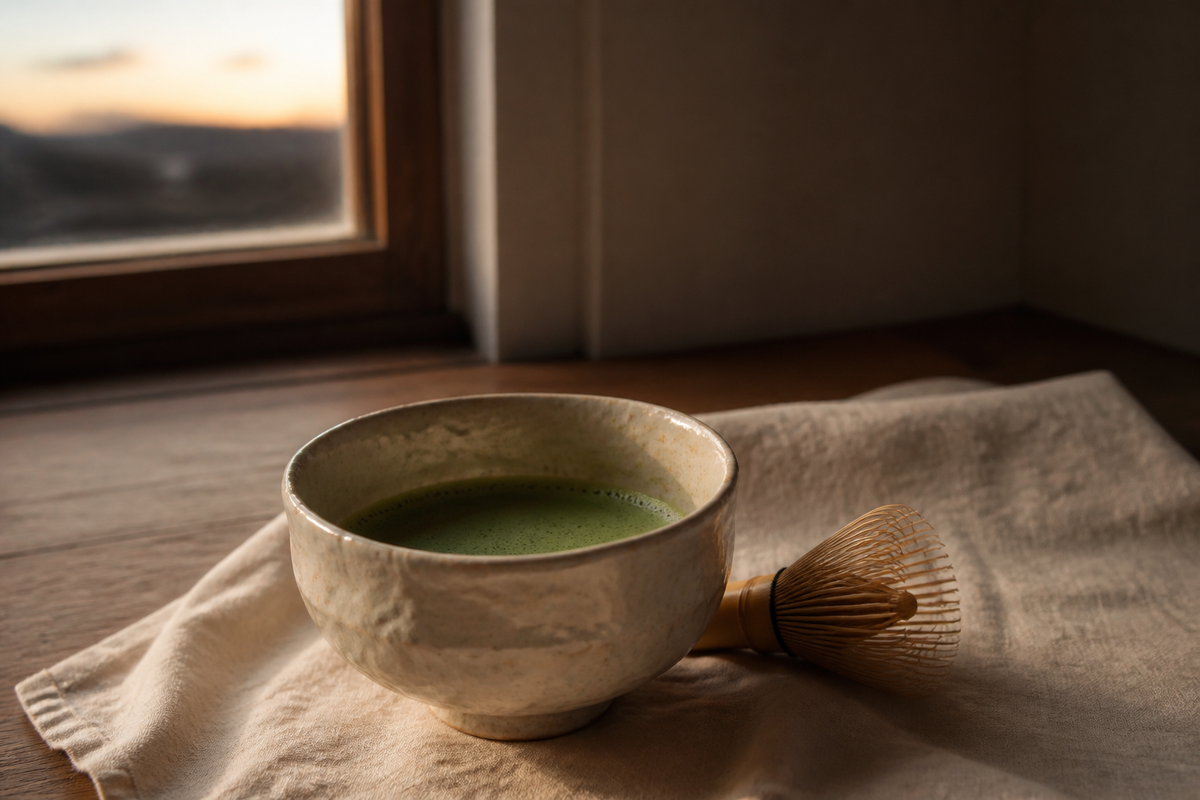
Using the standard serving — 2g (about one teaspoon) of matcha whisked into water — the numbers are fairly consistent across analyses. Two recent Japanese trials measured their matcha at 66.2mg caffeine per 2g serving (Uchida et al.) and 71.5mg per 2.7g serving, roughly 26mg per gram.[2][3] The commonly used planning figure of about 35mg per gram puts a 2g bowl near 70mg.
For comparison, an 8oz cup of brewed coffee delivers roughly 95mg, and a shot of espresso about 65mg. So a traditional bowl of matcha sits in espresso territory — lighter than a full coffee, but nowhere near decaf territory. Matcha also lands differently from steeped green tea: you consume the whole ground leaf rather than an infusion, so more of everything — caffeine, catechins, and L-theanine — ends up in the cup.
A 2g bowl of matcha carries roughly 60–70mg of caffeine — enough that its timing deserves the same respect you'd give an espresso.
What caffeine timing does to a night of sleep
The most rigorous recent answer comes from a 2023 systematic review and meta-analysis in Sleep Medicine Reviews, which pooled 37 controlled trials on caffeine and subsequent sleep.[1] Across studies, caffeine reduced total sleep time by about 45 minutes on average, cut sleep efficiency by roughly 7%, trimmed deep (N3) sleep by around 11 minutes, and added about 6 minutes of light N1 sleep. Wake after sleep onset increased by about 12 minutes.
The meta-regression is where the timing story gets practical. For every additional hour before bedtime that caffeine was consumed, the hit to total sleep time shrank by roughly 2.8 minutes.[1] Working from a standard cup of coffee (~107mg), the authors estimated you'd want to finish it at least 8.8 hours before bed to avoid measurable sleep reduction; a double-size 217.5mg dose pushed the cutoff out to 13.2 hours.
Extrapolating that to matcha's smaller dose: 60–70mg of caffeine is more forgiving than 107mg, but not categorically different. A bowl at 3pm before an 11pm bedtime — eight hours out — is right at the edge of what the pooled data would call safe. A bowl at 8pm is not.
Caffeine's effect on sleep is dose- and timing-dependent, with the meta-analysis suggesting a cutoff of roughly 8–9 hours before bed for coffee-sized doses — and matcha's smaller dose buys you only a little extra room.
The half-life problem: you're not "average"
Caffeine is cleared by the liver enzyme CYP1A2, and the gene behind it comes in fast and slow variants. The practical consequence: measured caffeine half-lives in healthy adults range from roughly 2 to 10 hours.[1] If you're a fast metabolizer, most of an afternoon bowl is gone by midnight. If you're a slow one, half of 3pm's caffeine may still be circulating at 11pm, and a meaningful fraction at 3am.
This is why the same bowl of matcha can be a non-event for one person and a 1am staring-at-the-ceiling event for another. Age, pregnancy, some medications (notably certain antidepressants and oral contraceptives), and smoking all shift clearance speed too. Rather than assuming you're average, the better experiment is personal: move your last bowl 90 minutes earlier for a week and watch your own sleep.
Caffeine clearance varies several-fold between people for genetic and lifestyle reasons — self-testing beats any published average.
Does L-theanine cancel the caffeine?
Here's where matcha's "calm energy" reputation earns some scrutiny. L-theanine is an amino acid found almost exclusively in tea, and it's the reason matcha's stimulation feels smoother than coffee's for many people. A 2g serving delivers roughly 40–50mg of it.[2][3]
On the sleep side specifically, the evidence is real but modest. A 2025 systematic review and meta-analysis in Sleep Medicine Reviews pooled trials of L-theanine (mostly 200–400mg doses) and found improvements in subjective sleep quality, sleep onset latency, and daytime dysfunction — with the caveat that most included trials were small and several were industry-funded.[4] The most-cited human trial, a 2019 randomized crossover study, gave healthy adults 200mg of L-theanine daily for four weeks and saw modest improvements in Pittsburgh Sleep Quality Index scores.[5]
Two honest qualifiers. First, those studies used isolated L-theanine at 200mg — four to five times what a single bowl of matcha delivers — and without caffeine alongside. Whether a bowl's ~45mg of theanine can meaningfully buffer its own ~70mg of caffeine is exactly the question the supplement trials don't answer. Second, "improves subjective sleep quality" is not "neutralizes caffeine at bedtime." No trial has shown L-theanine rescuing sleep from a late caffeine dose.
L-theanine has plausible sleep-supportive effects at 200mg isolated doses, but a bowl of matcha delivers about a quarter of that — alongside caffeine — so it shouldn't be treated as a built-in antidote.
What the matcha-specific trials actually found
Two recent Japanese trials tested matcha itself rather than its isolated components, and both are worth reading closely.
In a 2024 randomized, double-blind trial, healthy adults aged 27–64 consumed 2.7g of matcha daily (71.5mg caffeine, 50.3mg theanine) for four weeks while sleep was tracked by electroencephalography. The result: no significant differences in total sleep time, sleep latency, wake after sleep onset, or sleep efficiency versus placebo. Participants did report a trend toward greater sleep satisfaction, and post-wake grogginess measurably shortened.[2]
A second 12-month trial in adults aged 60–85 with mild cognitive decline used 2g of matcha daily (66.2mg caffeine, 48.1mg theanine) and observed improvements in subjective sleep quality and emotional perception.[3] Encouraging — but the population, the sponsorship (both trials were funded by matcha producers), and the subjective nature of the sleep findings all argue for caution before generalizing to healthy 35-year-olds.
What these trials suggest is narrower and more interesting than the marketing version: regular matcha intake at normal doses doesn't appear to wreck objective sleep in midlife adults — but neither trial pinned the timing question. Neither proves an evening bowl is harmless for a slow caffeine metabolizer.
Matcha-specific trials show no measurable EEG-level sleep disruption from daily matcha at 2–2.7g — a reassuring but limited signal, since none tested a late-evening bowl against a placebo.
Practical rules for matcha and sleep
- Set a personal cutoff, not a universal one. Start with 8–9 hours before bed (2pm for an 11pm sleeper). If you sleep fine, you have room; if you don't, move earlier.
- Count all your bowls, and your lattes doubly. Café matcha lattes often use 2–3 scoops and can exceed 100mg of caffeine — coffee territory.
- Watch the dose-dependent signs. Longer time to fall asleep, more midnight awakenings, or unrefreshing mornings after late matcha days are your clearest data.
- Consider your metabolism and life stage. If coffee at 2pm already costs you sleep, matcha at 5pm will too — the dose is smaller but same order of magnitude.
- If you want the evening ritual, decouple it from caffeine. A small bowl (1g, ~35mg) after an early dinner, or a caffeine-free herbal alternative after that, keeps the ceremony without the pharmacology.
The research above reflects findings from independent clinical trials, not claims about any specific product.
If you're mapping your own cutoff and want a ceremonial-grade powder that fits the 2g-standard figures used throughout this article, our 1.06oz starter tin is a reasonable place to start — one bowl's worth at a time is also the easiest way to run the self-experiment above.
These statements have not been evaluated by the FDA. This product is not intended to diagnose, treat, cure, or prevent any disease.
FAQ
How long before bed should I stop drinking matcha?
For most people, finishing matcha 8–9 hours before bedtime is a sensible starting cutoff, based on pooled caffeine-and-sleep data.[1] If you're sensitive to caffeine or a slow metabolizer, extend that to 10–12 hours. Adjust using your own sleep results rather than published averages.
Is matcha lower in caffeine than coffee?
Yes, but less than many people assume. A standard 2g bowl of matcha delivers roughly 60–70mg of caffeine — about two-thirds of an 8oz cup of coffee, and comparable to a single espresso shot.[2][3] Matcha lattes made with multiple scoops can match or exceed coffee.
Does L-theanine in matcha cancel caffeine's effect on sleep?
Not exactly. L-theanine has been associated with improved subjective sleep quality in trials using isolated 200mg doses.[4][5] A bowl of matcha delivers roughly 40–50mg of L-theanine alongside its caffeine, and no trial has shown that combination neutralizes caffeine's sleep effects at bedtime. Treat L-theanine as a moderating companion, not an antidote.
Can I drink matcha every day without harming my sleep?
Two recent trials found that daily matcha at 2–2.7g (66–72mg caffeine) didn't measurably alter objective sleep EEG over 4 weeks to 12 months, and was associated with modestly better subjective sleep quality.[2][3] Both were producer-funded, and neither tested evening timing specifically — so daily matcha before mid-afternoon appears reasonable, while late-night bowls remain untested.
Why does matcha affect my sleep more than my friend's?
Likely genetics. Caffeine is cleared by the CYP1A2 enzyme, whose fast and slow variants produce half-lives ranging from roughly 2 to 10 hours.[1] Slow metabolizers carry late-afternoon caffeine well into the night. Age, medications, and smoking also shift clearance.
References
- Gardiner C, Weakley J, Burke LM, et al. The effect of caffeine on subsequent sleep: A systematic review and meta-analysis. Sleep Medicine Reviews. 2023;69:101764.
- Baba Y, Takihara T, Okamura N. Matcha does not affect electroencephalography during sleep but may enhance mental well-being: A randomized placebo-controlled clinical trial. Nutrients. 2024;16(17):2907.
- Uchida K, Meno K, Korenaga T, et al. Effect of matcha green tea on cognitive functions and sleep quality in older adults with cognitive decline: A randomized controlled study over 12 months. PLoS ONE. 2024;19(8):e0309287.
- Bulman A, D'Cunha NM, Marx W, et al. The effects of L-theanine consumption on sleep outcomes: A systematic review and meta-analysis. Sleep Medicine Reviews. 2025;81:102076.
- Hidese S, Ogawa S, Ota M, et al. Effects of L-theanine administration on stress-related symptoms and cognitive functions in healthy adults: A randomized controlled trial. Nutrients. 2019;11(10):2362.

Written by Nippon Matcha