Key Takeaways
- Three ingredients, no machine. Full-fat coconut milk, sweetened condensed milk, and matcha — whisked in one bowl and frozen. No churn, no cooking, no ice cream maker.
- Fat and sugar are the anti-ice crew. Icy popsicles are a water problem. The fat in coconut milk and the sugar in condensed milk keep crystals small and the texture scoopably soft.
- Bloom the matcha in warm liquid first. Matcha clumps almost instantly in cold liquids. Whisk it into a few tablespoons of warm water before it meets the chilled base.
- Each pop carries roughly 40mg of caffeine. About half a cup of coffee per popsicle — a genuine afternoon lift, not a bedtime snack for kids.
- Freezing protects the green. Unlike baking, where heat and alkaline leavening dull chlorophyll, a cold freeze keeps matcha's color close to what you whisked.
Most matcha popsicle recipes fail in the same place: the freezer. The base tastes right in the bowl, then freezes into an ice block with a bitter green streak through the middle. The problem isn't the matcha — it's that the base is mostly water, and water alone freezes hard, large-crystalled, and bland.
The fix is three ingredients. Full-fat coconut milk brings the fat, sweetened condensed milk brings concentrated sugar and milk solids, and matcha brings everything else — color, grassy depth, and a slow, clean caffeine lift. Because you eat the whole ground leaf rather than steeping it, the compounds that give matcha its character — chlorophyll for the green, catechins like EGCG for the vegetal bite — land in the base in concentrated form [1]. Frozen, none of that gets poured off with the leaves.
Why three ingredients are enough
Popsicle texture is an ice-crystal problem. Pure water freezes into large, sharp crystals; that's what gives cheap popsicles their glassy bite. Fat coats the water droplets and sugar depresses the freezing point, so crystals stay small and the pop gives when you bite it instead of shattering [2]. Coconut milk and condensed milk handle both jobs at once, which is why there's no churning step — the base is stable enough to freeze still.
Matcha, for its part, is better off here than in most recipes. Heat is matcha's enemy — chlorophyll dulls in a hot oven, especially against alkaline leavening [2]. Freezing barely touches it. The color you whisk into the bowl is, a few hours later, the color on the stick.
Coconut milk for creaminess, condensed milk for sweetness and soft freeze, matcha for flavor and color — each ingredient earns its slot, and nothing else is needed.
Ingredients
Makes 10 standard popsicles.
- 2 cups (480ml) full-fat coconut milk, well shaken
- 3/4 cup (210g) sweetened condensed milk
- 2 tablespoons (about 12g) matcha powder, sifted
- Warm water, about 3 tablespoons (for blooming the matcha)
Steps
1. Bloom the matcha. Whisk the sifted matcha with 3 tablespoons of warm — not boiling — water into a smooth, dark paste. Keep going until it's glossy with no dry pockets; this is the step that decides whether your popsicles are streak-free.
2. Mix the base. In a large bowl, stir the coconut milk and condensed milk together until uniformly combined.
3. Combine. Add the matcha paste to the base and whisk until the whole mixture is one even shade of green with no darker ribbons.
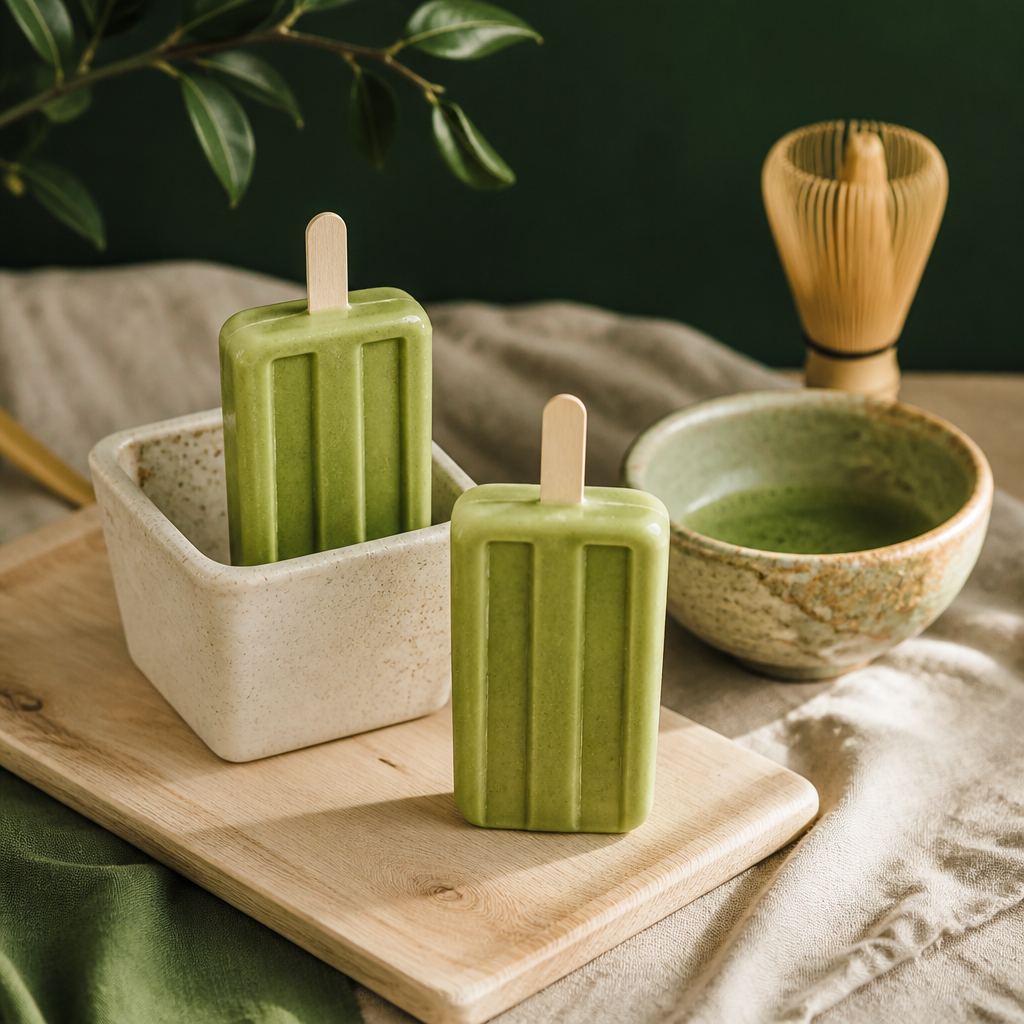
4. Fill the molds. Pour into popsicle molds, leaving about a quarter inch of headroom for expansion. Tap the molds on the counter to release air bubbles, insert the sticks, and freeze at least 6 hours — overnight is better.
5. Unmold and serve. Run warm water over the outside of each mold for 10-15 seconds and pull gently. The pop should release whole.
The one matcha tip that matters most
Never let matcha meet a cold liquid directly. The fine particles hydrate slowly in cold liquid and grab each other the moment they touch, forming the clumps that survive the freezer as bitter flecks. Warm water lets the powder disperse first, and a paste blended into a cold base stays smooth all the way to the stick.
The second half of the tip: sift, always. Matcha is stone-milled but it settles and compacts in the tin, and a sift takes ten seconds against a whisking session that never quite catches every dry pocket.
A note on caffeine
These are not kid-neutral. Two tablespoons of matcha across ten pops works out to about 1.2g per pop, and at the standard estimate of roughly 35mg of caffeine per gram of matcha, that's about 40mg per popsicle [1] — roughly half a small cup of coffee. Fine for an afternoon; worth knowing before the third one. If you're making these for children or anyone caffeine-sensitive, halve the matcha — the color softens to a paler mint but the flavor still reads.
The research above reflects findings from independent studies, not claims about any specific product.
If you want a matcha with enough color and aroma to carry a frozen recipe, our 1.06oz ceremonial-grade tin covers this batch and a few weeks of bowls besides.
These statements have not been evaluated by the FDA. This product is not intended to diagnose, treat, cure, or prevent any disease.
Frequently Asked Questions
Why did my popsicles freeze icy instead of creamy?
Almost always low fat or low sugar. Use full-fat coconut milk — the light versions are mostly water and freeze hard — and don't cut the condensed milk. Adding a tablespoon of honey also helps keep the texture softer at freezer temperature.
Can I make these dairy-free?
Yes, easily — coconut milk already is. To make them fully dairy-free, swap the condensed milk for condensed coconut milk (sold in cans) or use maple syrup, adding about 1/4 cup and tasting as you go. The texture is a touch firmer with maple but still soft enough to bite.
How much caffeine is in a matcha popsicle?
About 40mg per pop with the recipe as written — roughly half a small cup of coffee. Matcha also contains L-theanine, which research suggests may moderate how the caffeine is experienced, but a popsicle is still a real caffeine source [1][3]. Kids and caffeine-sensitive adults should get the half-matcha version.
Can I use culinary-grade matcha?
Yes, and this is one of the better places for it. Freezing mutes aromatics more than a straight bowl of tea does, so the gap between culinary and ceremonial grade narrows. The color is the main difference — culinary grade runs duller and more olive, ceremonial a brighter jade.
How do I get popsicles out of the mold without breaking them?
Warm water, patience, ten seconds. Hold the mold under a trickle of warm water, then pull the stick with steady, even pressure — a twist at the top is what snaps them. If the base is icy and still gripping, run the water a few seconds longer rather than forcing it.
References
- Kochman J, Jakubczyk K, Antoniewicz J, Mruk H, Janda K. Health Benefits and Chemical Composition of Matcha Green Tea: A Review. Molecules. 2020;26(1):85. doi:10.3390/molecules26010085
- Jakubczyk K, Kochman J, Kwiatkowska A, et al. Antioxidant Properties and Nutritional Composition of Matcha Green Tea. Foods. 2020;9(4):483. doi:10.3390/foods9040483
- Sokary S, Al-Asmakh M, Zakaria Z, Bawadi H. The therapeutic potential of matcha tea: A critical review on human and animal studies. Current Research in Food Science. 2023;6:100396. doi:10.1016/j.crfs.2022.100396