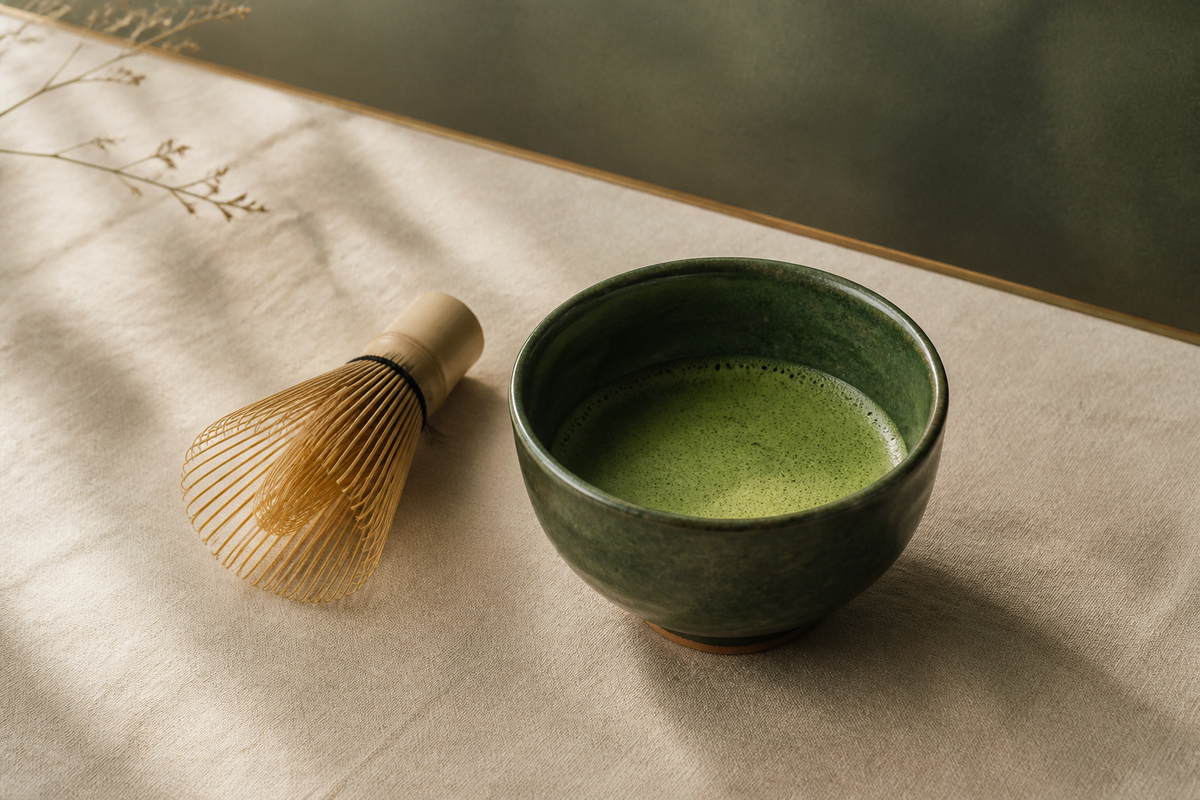
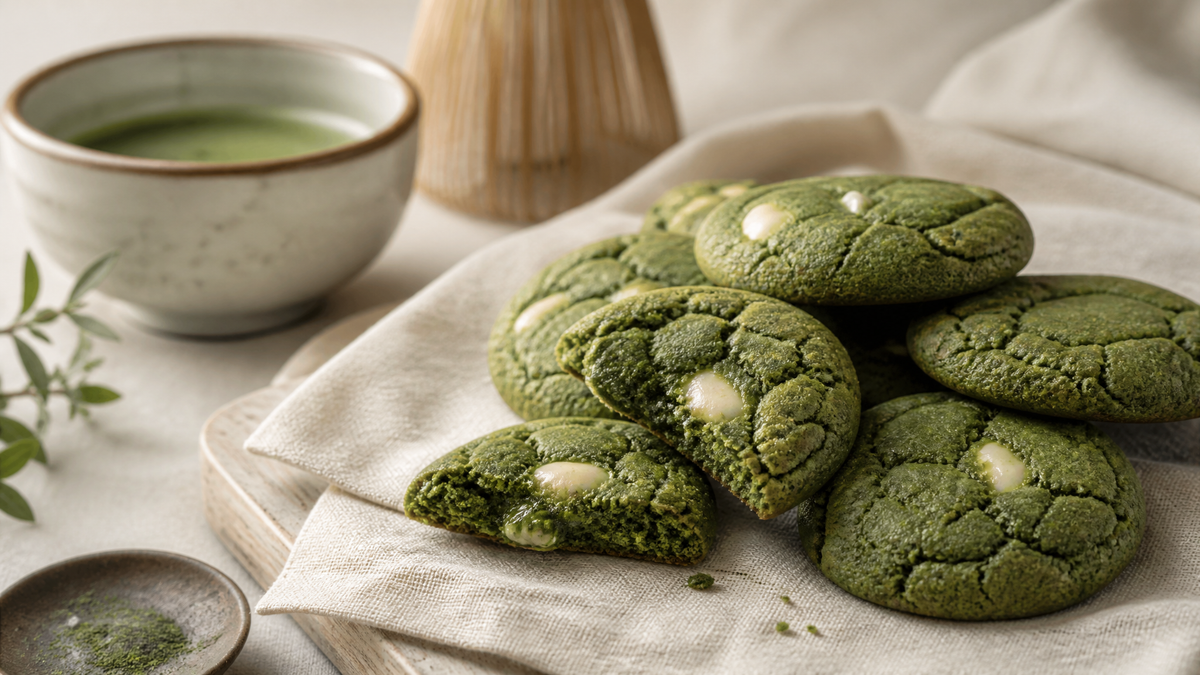
Most matcha cookies fail for a boring reason: the recipe treats matcha like cocoa powder. But matcha isn't chocolate — it's a finely milled whole leaf with delicate catechins that turn bitter and dull the moment you push them too far. Get the details right (sifting, temperature, timing), and you get something genuinely special: a soft, chewy cookie with a buttery crumb, a gently grassy flavor, and that unmistakable jade-green color.
Key Takeaways
- Sift the matcha with the flour — unsifted matcha clumps, leaving bitter green specks instead of even color and flavor.
- Brown sugar is the chew factor — more brown sugar than white keeps the centers soft for days.
- Don't overbake. The cookies should look slightly underdone at 10–12 minutes; carryover heat finishes them and preserves the green color.
- A 2g (1 tsp) serving of matcha adds roughly 35 mg of caffeine across the batch — this recipe uses about 1½ teaspoons total, so each cookie carries only a gentle amount.
- White chocolate and matcha are a classic pairing for a reason: the creamy sweetness balances matcha's natural astringency.
Why Matcha Works in Cookies
Matcha is the ground whole tea leaf, so you consume everything — including the catechins that give green tea its characteristic astringency. In a drink, that astringency reads as pleasant briskness. In a cookie, it needs fat and sugar to soften around it, which is exactly what a buttery dough provides.
There's also a practical upside. Because you eat the whole leaf, matcha retains its catechin content even in baked applications — though heat does degrade some of the more delicate compounds, and research on green tea catechins shows significant thermal degradation above typical baking temperatures.[1] Realistically, you're baking these cookies for flavor and color first; any catechins that survive the oven are a bonus, not the point.
The caffeine story is more forgiving. A 2g serving (1 teaspoon) of matcha contains roughly 35 mg of caffeine — about a third of a cup of coffee.[2] Spread across 18 cookies, this recipe delivers a few milligrams per cookie. You can have one with your evening tea without worrying about your sleep.
Matcha cookies are a dessert first and a source of tea compounds a distant second — bake them for the flavor and color, not the antioxidants.
Ingredients
Makes about 18 cookies
- 2 cups (250 g) all-purpose flour
- 1½ tablespoons ceremonial-grade matcha powder
- ½ teaspoon baking soda
- ½ teaspoon fine sea salt
- ¾ cup (170 g) unsalted butter, softened
- ¾ cup (150 g) brown sugar, packed
- ¼ cup (50 g) granulated sugar
- 1 large egg + 1 egg yolk, room temperature
- 2 teaspoons vanilla extract
- ¾ cup (130 g) white chocolate chips or chopped white chocolate
Instructions
- Sift the dry ingredients. Whisk the flour, matcha, baking soda, and salt together, then push the mixture through a fine-mesh sieve into a bowl. Matcha's particle size means it clumps readily — sifting twice isn't overkill if you want a uniform green crumb.
- Cream the butter and sugars. Beat the softened butter with the brown sugar and granulated sugar for 2–3 minutes, until pale and fluffy. This traps air that gives the cookies lift and keeps the centers from turning dense.
- Add the egg, yolk, and vanilla. Mix in the whole egg, then the yolk, then the vanilla. The extra yolk adds fat and emulsifiers, which is a big part of the chew.
- Combine gently. Add the dry mixture to the wet in two additions, mixing on low just until no dry flour remains. Fold in the white chocolate. Overmixed dough makes tough cookies.
- Chill the dough. Cover and refrigerate for at least 30 minutes (up to 24 hours). Chilling solidifies the butter, which means thicker cookies that spread less and stay chewy in the middle.
- Scoop and bake. Heat the oven to 350°F (175°C). Scoop 1½-tablespoon balls onto a parchment-lined sheet, spacing them 2 inches apart. Bake 10–12 minutes, until the edges are set but the centers still look soft and slightly wet. Do not wait for them to look done.
- Cool on the pan. Let the cookies rest on the baking sheet for 5 minutes — carryover heat finishes the centers — then transfer to a rack. They'll firm up as they cool but stay chewy for 3–4 days in a sealed container.
The Matcha Tip
Color is your timer. Matcha's green dulls toward khaki with heat and time, so a cookie baked until it looks fully done in the oven will come out olive-toned and slightly bitter. Pull them when the centers still look underbaked — the residual heat on the pan finishes the job while preserving both the color and the soft texture. And keep the matcha away from direct, high oven contact: an oven that runs hot will toast the bottom of the cookie brown before the center sets. If your cookies consistently come out khaki, drop the temperature to 340°F and add a minute.
The research referenced above reflects findings from independent studies, not claims about any specific product. If you're baking regularly, Nippon Matcha's 1.06 oz tin covers roughly a dozen batches of these cookies — ceremonial-grade, stone-ground in Uji, with the kind of fresh green color this recipe depends on.
These statements have not been evaluated by the FDA. This product is not intended to diagnose, treat, cure, or prevent any disease.
Frequently Asked Questions
Can I use culinary-grade matcha for cookies?
You can, and many bakers do — but expect a more astringent, slightly bitter result and a duller green color. Culinary-grade matcha is made from later-harvest leaves with more tannic structure. If culinary-grade is what you have, reduce it to 1 tablespoon and lean a bit harder on the white chocolate.
Why did my matcha cookies turn brown (or khaki)?
Two likely causes: overbaking, or too little matcha. Matcha loses its vivid green above about 350°F and with extended baking time. Pull the cookies while the centers still look soft, and make sure you're using a full 1½ tablespoons per 2 cups of flour.
Can I make the dough ahead of time?
Yes — the dough keeps in the fridge for up to 48 hours and freezes beautifully. Scoop the balls, freeze them solid on a tray, then bag them. Bake from frozen at the same temperature, adding 1–2 minutes.
How much caffeine is in a matcha cookie?
Very little. A teaspoon (2g) of matcha contains roughly 35 mg of caffeine — about a third of a cup of coffee — and this recipe uses about 1½ teaspoons spread across 18 cookies. Each cookie carries only a few milligrams, comparable to a square of chocolate.
Can I skip the white chocolate?
You can leave it out entirely, but the cookies will taste noticeably more bitter — white chocolate's sweetness and dairy fat are doing real work balancing the matcha. If you'd rather not use white chocolate, try macadamia nuts or a light vanilla glaze instead.