Key Takeaways
- Whisk the matcha into the milk, not into the flour. That is the whole trick — no green specks, no clumps, even color in every pancake.
- Keep the batter lumpy. Overmixing develops gluten and turns a soft stack tough overnight. A few small lumps are exactly right.
- Two tablespoons of matcha flavors the whole batch. Enough leaf to taste through butter and syrup, and to tint the crumb naturally — no food dye.
- A three-pancake stack carries roughly 150mg of caffeine. In the range of a strong brewed coffee, not a decaf brunch. Rinse with that in mind.
- One flip, medium heat, wait for the bubbles. Flip when the edges look set and bubbles hold their shape — then leave it alone.
Pancakes break quietly. They go tough from overmixing, rubbery from a cold pan, and flat from batter that sat too long. Matcha, oddly, is not on that list of risks — it slots into the batter just fine. What it adds is the one thing a pancake breakfast usually lacks: a dry, grassy edge to cut through butter and syrup, and a color you cannot fake with food coloring.
Matcha is a fine powder made from shade-grown tea leaves that are steamed, dried, and stone-ground whole [1]. Because you eat the leaf rather than steep it, the compounds that give matcha its flavor and color — chlorophyll for the green, catechins like EGCG for the vegetal bite — land in concentrated form [2]. In a stack of pancakes that means a couple of tablespoons carries enough of both to read through flour, milk, and butter.
Why matcha and pancakes work together
Pancake batter is sweet and bland and, once syrup hits, very sweet. Matcha is the counterweight: slightly bitter, faintly vegetal, and aromatic in a way that survives the griddle. The same astringency that can read as harsh in a straight bowl of tea softens into a pleasant depth when it's baked into a tender, buttery crumb.
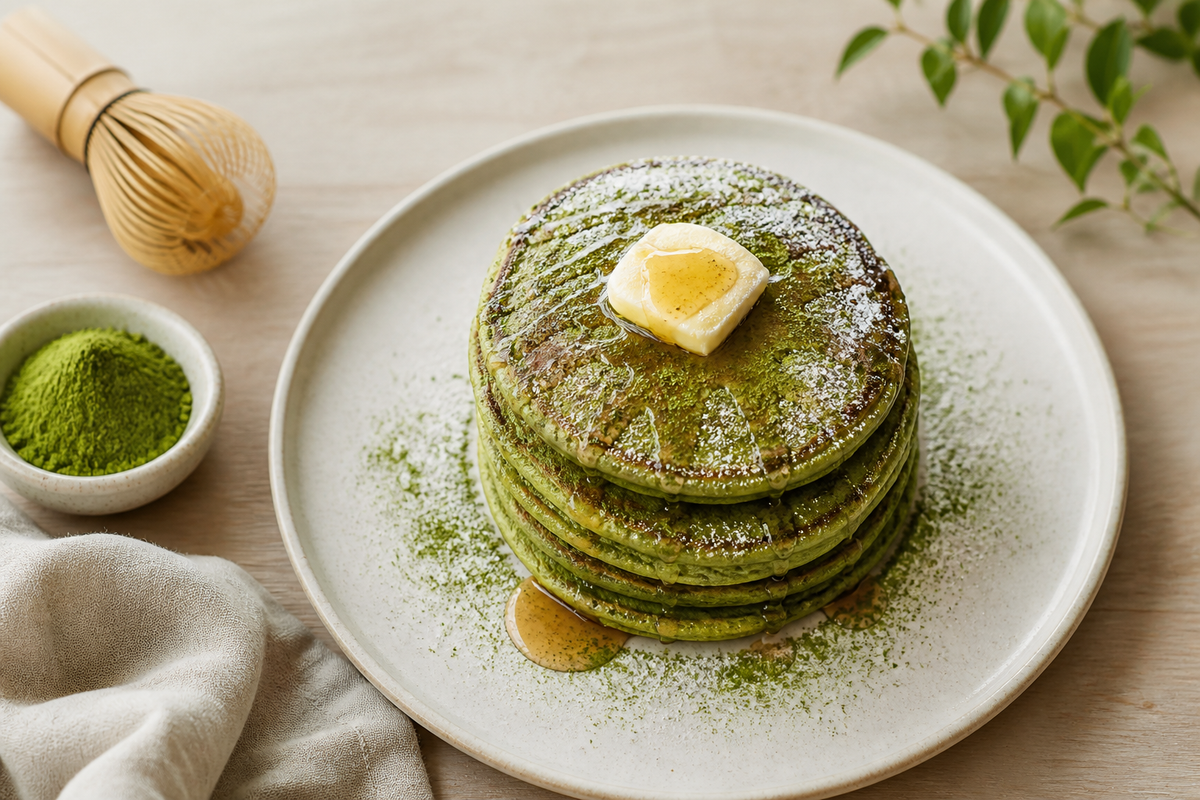
The color is the bigger tell. Real matcha turns the batter a soft jade before cooking and a muted sage after, because chlorophyll dulls as it heats in contact with the alkaline leavening in baking powder [2]. That is normal — a neon-green pancake has either been dyed or heavily filtered for a photo, not honestly cooked.
Matcha is doing two jobs in this recipe — flavor and color — and the dosing is what keeps both in line: enough to taste, not enough to tip into bitterness.
Ingredients
Makes about 8 medium pancakes (two to three servings).
- 1 1/2 cups (190g) all-purpose flour
- 2 tablespoons (about 12g) matcha powder, sifted
- 2 tablespoons granulated sugar
- 2 teaspoons baking powder
- 1/2 teaspoon fine sea salt
- 1 1/4 cups (300ml) whole milk
- 1 large egg
- 2 tablespoons unsalted butter, melted (plus more for the pan)
- 1 teaspoon vanilla extract
Steps
1. Whisk the dry. In a large bowl, whisk together the flour, sugar, baking powder, and salt. Sift the matcha in with them and whisk again until the green is evenly distributed — no streaks.
2. Bloom the matcha in the milk. In a separate bowl, whisk the milk, egg, melted butter, and vanilla. Then whisk the matcha into this liquid base until fully dissolved and uniformly green. Blooming the powder in liquid first — before it ever meets the flour — is what guarantees a streak-free batter.
3. Combine, barely. Pour the wet into the dry and stir with a spatula just until no dry flour remains. The batter should still be lumpy. Stop the moment it comes together.
4. Rest five minutes. Let the batter sit at room temperature. The flour hydrates and the baking powder starts its work, which is what gives you a taller, fluffier rise.
5. Cook on medium heat. Melt butter in a nonstick pan or griddle over medium heat. Pour about 1/4 cup of batter per pancake. Cook until bubbles form on top and the edges look set, about 2–3 minutes, then flip once and cook another 1–2 minutes until the second side is golden.
6. Stack and serve. Keep finished pancakes warm on a plate in a low oven while you work through the batter. Serve in a stack with butter and maple syrup.
The one matcha tip that matters most
Dissolve the matcha into the milk before it touches the flour. Matcha is a suspension, not a solution — the fine particles clump the instant they meet a dry or starchy surface all at once. Whisking it into the liquid base disperses the powder evenly, so every pancake comes out the same shade of green with no bitter flecks. If you want extra insurance, whisk the matcha with a few tablespoons of the milk into a smooth paste first, then add the rest.
The flip side of that tip: once the flour is in, stop stirring. Overworked batter turns the pancakes dense and chewy, and no amount of matcha will rescue the texture. A few small lumps in the bowl are a good sign, not a mistake.
A note on caffeine
Matcha contains caffeine, and the griddle doesn't remove it. Two tablespoons of matcha across a batch of eight pancakes works out to roughly 1.5g per pancake, and at the standard estimate of about 35mg of caffeine per gram of matcha, that is about 50mg per pancake [1]. A three-pancake stack lands around 150mg — in the range of a strong brewed coffee, not a quiet cup. Fine for a weekend morning, worth knowing if you're planning a nap after brunch.
If you're serving kids or anyone caffeine-sensitive, cut the matcha to one tablespoon; the color will be lighter but the batter still holds its own.
The research above reflects findings from independent studies, not claims about any specific product.
If you want matcha with enough color and body to carry a recipe like this, our 1.06oz ceremonial-grade tin is a solid starting point — one tin covers this batter plus a week of morning matcha.
These statements have not been evaluated by the FDA. This product is not intended to diagnose, treat, cure, or prevent any disease.
Frequently Asked Questions
Why do my matcha pancakes turn brown instead of green?
Heat and the alkaline baking powder are the usual culprits. Chlorophyll dulls when cooked, especially against alkaline leavening, so a dark or olive tint is normal. To keep more green, use fresh matcha, sift it well, and cook over medium rather than high heat — aggressively browned pancakes read brown, not green.
Can I make these dairy-free or lower-sugar?
Yes, mostly. Swap the whole milk for oat or almond milk and the butter for melted coconut oil or a neutral oil; the rise holds fine. Lower-sugar is easier here than in ice cream — cut the sugar to one tablespoon and let the syrup do the sweetening at the table.
Can I use culinary-grade matcha for this?
You can. Culinary-grade matcha is more astringent, which in a butter-and-syrup pancake is actually fine — the fat and sweetness soften it. The trade-off is color and aroma: culinary grade is duller and more vegetal than ceremonial. Either works; the green just deepens with better matcha.
Why are my pancakes dense instead of fluffy?
Almost always overmixing. Stirring the batter until smooth develops the gluten that makes pancakes tough and flat. Mix until just combined — lumps included — then rest the batter five minutes before it hits the pan. Check that your baking powder is fresh, too.
Can I cook these ahead and reheat them?
Yes. Cool the pancakes on a wire rack, then layer them with parchment and refrigerate for up to three days or freeze for a month. Reheat in a toaster or a 350°F (175°C) oven — not the microwave, which steams them soft and soggy.
References
- Kochman J, Jakubczyk K, Antoniewicz J, Mruk H, Janda K. Health Benefits and Chemical Composition of Matcha Green Tea: A Review. Molecules. 2020;26(1):85. doi:10.3390/molecules26010085
- Jakubczyk K, Kochman J, Kwiatkowska A, et al. Antioxidant Properties and Nutritional Composition of Matcha Green Tea. Foods. 2020;9(4):483. doi:10.3390/foods9040483
- Sokary S, Al-Asmakh M, Zakaria Z, Bawadi H. The therapeutic potential of matcha tea: A critical review on human and animal studies. Current Research in Food Science. 2023;6:100396. doi:10.1016/j.crfs.2022.100396