Key Takeaways
- No-churn means no machine, no eggs, no stovetop. Sweetened condensed milk keeps ice crystals small; whipped cream traps the air.
- Whisk the matcha into the condensed milk first. That is the whole trick for a smooth, streak-free green base.
- Matcha does the coloring and the flavor. No food dye, no floral extracts. The grassy astringency cuts straight through condensed milk's sweetness.
- A half-cup scoop carries roughly 50mg of caffeine. About a shot of espresso. Worth knowing before a late-night bowl.
- Freeze at least 6 hours, then rest 5 minutes on the counter. That gets you a scoopable, creamy texture without an ice-cream maker.
No-churn ice cream is the rare kitchen shortcut that doesn't cost you anything in texture. The mechanism is chemistry rather than machinery: sweetened condensed milk holds enough dissolved sugar and milk solids to keep water from freezing into large, gritty crystals, while whipped cream traps millions of tiny air pockets. The result sets up soft and scoopable, no churning required.
Matcha slots into that base almost too well. It brings concentration, so a couple of tablespoons flavor an entire quart. It brings color, so the ice cream is green because of the leaf, not a bottle of dye. And its dry, slightly astringent edge is exactly what a base built on condensed milk needs — the sweetness needs something sharp to push against, or the whole thing lands flat and cloying.
Why matcha and no-churn work together
Matcha is a fine powder made from shade-grown tea leaves that are steamed, dried, and stone-ground whole [1]. Because you consume the leaf rather than an infusion, the compounds that give matcha its color and flavor — chlorophyll for the green, catechins such as EGCG for the vegetal bitterness — arrive in concentrated form [2]. In ice cream, that concentration matters: a small amount of powder carries enough chlorophyll to tint a quart and enough flavor to read through cold and fat.
Cold mutes flavor, which is why most no-churn matcha recipes taste faint or over-sweet. The fix is the dosing. Two tablespoons (about 12g) of matcha in a quart is enough to keep the green assertive after freezing. Less, and the ice cream reads as "sweet cream with a greenish cast" rather than matcha.
Matcha does two jobs here: it is the flavor and the color. You need enough of it to do both without tipping into bitterness.
Ingredients
Makes about 1 quart (roughly 8 half-cup scoops).
- 1 can (14 oz / 397g) sweetened condensed milk
- 2 cups (480ml) cold heavy cream
- 2 tablespoons (about 12g) matcha powder, sifted
- 1 teaspoon vanilla extract
- Pinch of fine sea salt
Steps
1. Whisk the matcha into the condensed milk. Pour the condensed milk into a large bowl. Sift the matcha over it, then whisk hard until the powder is completely dissolved and the mixture is uniformly green with no flecks. Add the vanilla and salt with it. This step is non-negotiable: matcha clumps the instant it meets liquid that isn't already carrying it, and once the cream is folded in you cannot rescue a streaky base.
2. Whip the cream. In a separate bowl, whip the cold heavy cream to medium-firm peaks — when you lift the whisk, the peak should stand up but the tip should just bend over. Stop before it turns grainy; over-whipped cream makes the finished ice cream heavy.
3. Fold in three additions. Scoop about a third of the whipped cream into the matcha mixture and stir it in to loosen the base. Fold in the remaining cream in two more additions with a wide spatula, using big, gentle strokes and scraping the bottom each time. Stop as soon as no white streaks remain.
4. Freeze. Scrape the mixture into a loaf pan or a lidded container, smooth the top, and press a sheet of parchment directly onto the surface. Freeze for at least 6 hours, ideally overnight.
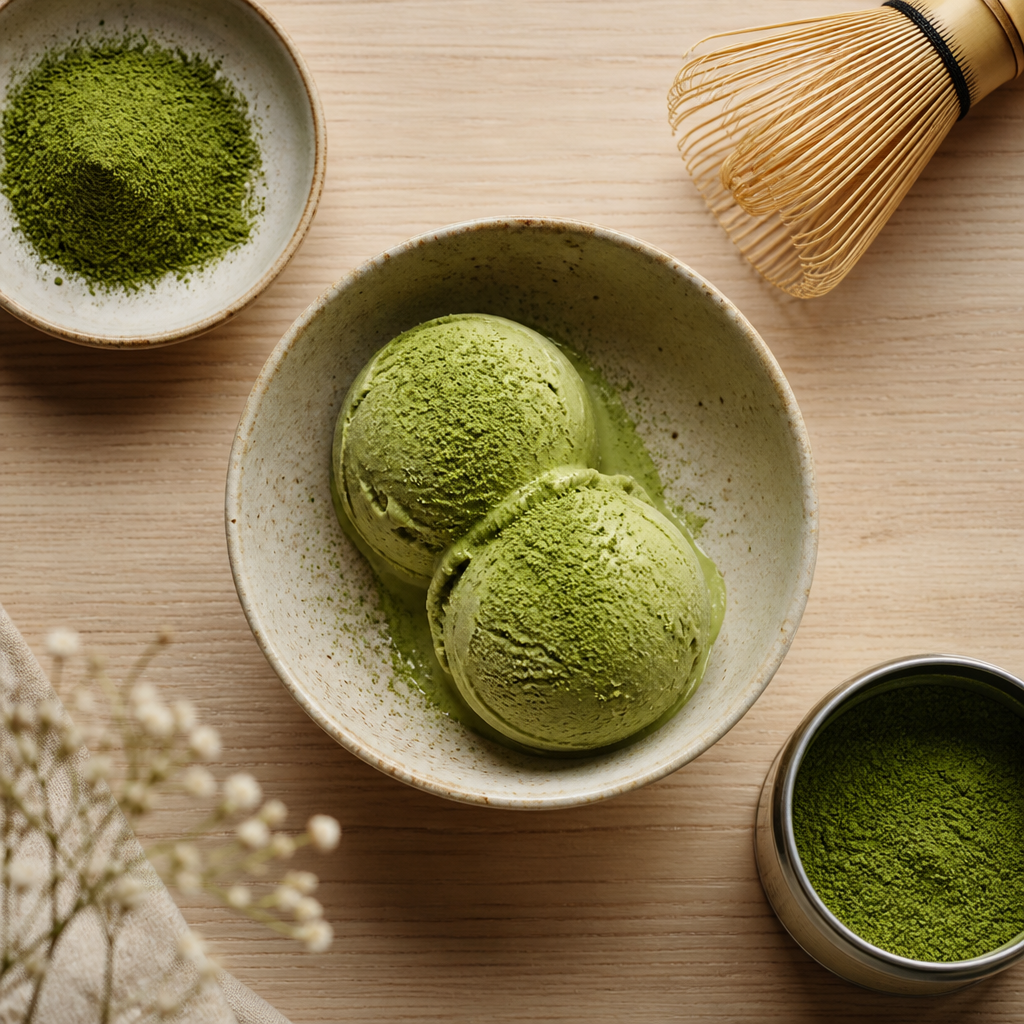
5. Scoop. Let the container sit at room temperature for about 5 minutes before scooping. A warm scoop dipped in hot water between each pass makes clean spheres.
The one matcha tip that matters most
Dissolve the matcha into the condensed milk, not into water and never directly into the cream. Matcha is a suspension, not a solution — the fine particles coat themselves in liquid and ball up if they are introduced to a thin liquid all at once. Condensed milk is thick and syrupy, which lets the particles disperse evenly instead of clumping. If you prefer to bloom the matcha first, whisk it with a few tablespoons of the condensed milk into a smooth paste before adding the rest. Either way, the goal is the same: no dry flecks before the cream ever enters the bowl.
Storage and a note on color
Keep it in a sealed container with parchment pressed to the surface, and it holds well for up to two weeks. The green will soften over time — chlorophyll breaks down slowly even at freezer temperature, and the surface is where it happens first — so scoop from the center and press the plastic right back down. The flavor outlasts the color, so a week-old pint that has dulled from jade to sage will still taste like matcha.
Expect the color to fall somewhere between jade and sage green on day one. Bright neon-green matcha ice cream is either heavily filtered for a photo or has had extra coloring added; real matcha in a cream base lands softer and more natural [2].
A note on caffeine
Matcha contains caffeine, and freezing doesn't remove it. Two tablespoons (about 12g) of matcha across a full quart works out to roughly 1.5g per half-cup serving, and at the standard estimate of about 35mg of caffeine per gram of matcha, that is roughly 50mg per scoop — in the same range as a single shot of espresso [1]. Not enormous, but not nothing if you are sensitive or serving it after dinner.
The caffeine and catechins that make matcha what it is are the same compounds people most often ask about, and reviews of matcha's composition consistently note their concentration in the whole leaf [1][2][3]. None of that changes in a frozen dessert — the compounds are present, just delivered in a less concentrated, more indulgent package.
The research above reflects findings from independent studies, not claims about any specific product.
If you want matcha smooth enough for a bowl and green enough to carry a dessert, our 1.06oz ceremonial-grade tin is a reasonable starting point — one tin covers this recipe plus a week of morning matcha.
These statements have not been evaluated by the FDA. This product is not intended to diagnose, treat, cure, or prevent any disease.
Frequently Asked Questions
Why is my no-churn matcha ice cream icy instead of creamy?
Almost always the cream or the temperature. If the cream was not whipped to medium-firm peaks there isn't enough trapped air, and if you didn't fully dissolve the matcha into the condensed milk you'll get both lumps and weepy texture. Freezing it uncovered, or freezing for only a few hours, also produces a harder, icier set. Press parchment to the surface and give it the full six hours.
Can I use culinary-grade matcha for this?
You can. Culinary-grade matcha is more astringent, which in a dessert is less of a problem than in a bowl — the condensed milk and cream do the softening for you. The trade-off is color and aroma: culinary grade leans duller and more vegetal. If that's what you have, it will still work; just expect a more muted green.
Does matcha ice cream contain caffeine?
Yes, in proportion to how much matcha you add. At two tablespoons per quart, a half-cup scoop carries roughly 50mg of caffeine, comparable to a shot of espresso. Reduce the matcha to one tablespoon if you want a dessert you can serve late in the evening.
Can I make this dairy-free or lower-sugar?
Partially. A 1:1 swap to full-fat coconut cream for the heavy cream works and adds a pleasant coconut note; coconut condensed milk can replace the sweetened condensed milk for a fully dairy-free version, though the texture will be slightly softer. There is no clean lower-sugar route — condensed milk is doing structural work here, not just sweetening, so sugar substitutes won't set the same way.
How long does matcha ice cream keep its color?
The flavor holds for up to two weeks frozen, but the green softens within days as chlorophyll degrades, starting at the exposed surface. Scoop from the center, keep parchment pressed to the surface, and serve it within the first week if the color matters to you.
References
- Kochman J, Jakubczyk K, Antoniewicz J, Mruk H, Janda K. Health Benefits and Chemical Composition of Matcha Green Tea: A Review. Molecules. 2020;26(1):85. doi:10.3390/molecules26010085
- Jakubczyk K, Kochman J, Kwiatkowska A, et al. Antioxidant Properties and Nutritional Composition of Matcha Green Tea. Foods. 2020;9(4):483. doi:10.3390/foods9040483
- Sokary S, Al-Asmakh M, Zakaria Z, Bawadi H. The therapeutic potential of matcha tea: A critical review on human and animal studies. Current Research in Food Science. 2023;6:100396. doi:10.1016/j.crfs.2022.100396