Key Takeaways
- One mug, one fork, about 90 seconds of cooking. Flour, sugar, matcha, baking powder, milk, and melted butter — mixed right in the mug and microwaved.
- No egg, on purpose. A whole egg is too much protein for a single-serving cake and is the main reason mug cakes turn rubbery. Milk and butter give a softer, more cake-like crumb.
- Sift the matcha into the flour, not the milk. Dispersing it through the dry ingredients first is what keeps the cake evenly green with no bitter pockets.
- Undercook slightly. Stop when the top looks just set. Residual heat finishes it, and overcooking is what dulls the color and dries the crumb.
- One teaspoon (2g) of matcha carries roughly 70mg of caffeine — a bit less than a typical cup of coffee, so this is an afternoon dessert, not a midnight one.
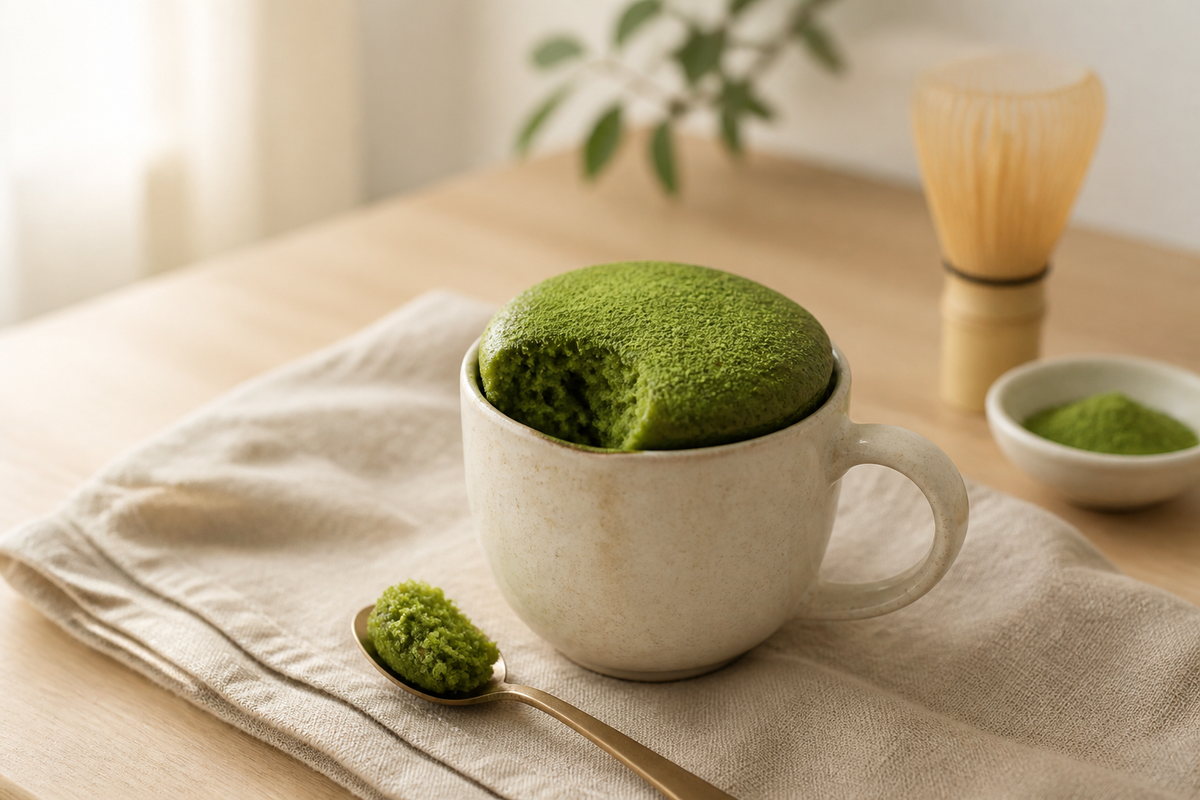
A matcha mug cake is the fastest route from "I want something sweet" to a warm, green, genuinely cake-like dessert. Six pantry ingredients, one mug, and about 90 seconds in the microwave. No oven to preheat, no mixing bowl to wash.
The catch is that most mug cakes are bad. They come out spongy, rubbery, or dry around the edges, and matcha versions often add a second problem: streaks of bitter, undissolved powder. Both are fixable, and the fixes are simple.
Why most mug cakes turn rubbery
The usual culprit is the egg. A standard egg is sized for a recipe that serves eight, not one. Dropped into four tablespoons of flour, its proteins set firm in the microwave and give you the springy, bouncy texture people associate with mug cakes. Leave it out, and the cake relies on baking powder for lift and on butter and milk for tenderness — which is how you get a soft, open crumb instead of a sponge.
The second culprit is time. Microwaves heat from the inside and keep cooking after the timer ends. Push a mug cake until the top looks fully dry, and the center will be overdone by the time you take your first bite.
Skip the egg and stop cooking early — those two decisions do most of the work of making a mug cake taste like real cake.
Ingredients
Makes 1 mug cake. Use a microwave-safe mug that holds at least 12oz (350ml) so the batter has room to rise.
- 4 tablespoons (32g) all-purpose flour
- 2 1/2 tablespoons (30g) granulated sugar
- 1 teaspoon (2g) matcha powder, sifted
- 1/4 teaspoon baking powder
- Small pinch of salt
- 3 tablespoons (45ml) milk, dairy or oat
- 1 1/2 tablespoons (20g) unsalted butter, melted (or neutral oil)
- 1/4 teaspoon vanilla extract
- Optional: 1 tablespoon white chocolate chips
Steps
1. Melt the butter in the mug. Microwave the butter in your mug for 15-20 seconds until just melted. Swirl it around to coat the inside — this doubles as greasing.
2. Add the wet ingredients. Stir in the milk and vanilla with a fork.
3. Sift in the dry ingredients. Sift the flour, sugar, matcha, baking powder, and salt directly over the mug (or whisk them together in a small cup first). Stir with the fork until the batter is smooth and evenly green, scraping the bottom edges where dry flour hides. Fold in the white chocolate chips, if using.
4. Microwave. Cook on high for 70 seconds, then check. The cake should be risen with a top that looks set but still slightly glossy in the center. If it's wet, continue in 10-second bursts. Most 1000-watt microwaves land between 70 and 90 seconds; lower-wattage models may need up to 2 minutes.
5. Rest and serve. Let it sit for one minute — the center finishes setting as it cools. Eat it straight from the mug, ideally with a spoonful of whipped cream or vanilla ice cream on top.
The one matcha tip that matters most
Get the matcha into the flour before it meets any liquid. Matcha is milled extremely fine, and those particles cling to each other the moment they touch milk, forming small clumps that stay intact through a 90-second cook. Each one becomes a bitter, dark-green fleck. Sifted and stirred through the dry ingredients first, the powder is already spread out when the milk arrives, and it hydrates evenly.
Color is the other reason to be careful. Much of matcha's green comes from chlorophyll, which the shade-growing process concentrates in the leaf [1]. Chlorophyll fades toward olive with prolonged heat and in alkaline batters, which is why this recipe uses baking powder rather than baking soda and keeps cooking time short. A microwave mug cake actually has an advantage over an oven-baked cake here: 90 seconds of heat dulls the color far less than 30 minutes at 350°F.
Sift the matcha into the dry ingredients and keep the cook short — that gives you even flavor and a cake that's still green when you eat it.
A note on caffeine
Because you eat the whole ground leaf, a teaspoon of matcha in a cake delivers the same caffeine as a teaspoon whisked into a bowl of tea. At roughly 35mg per gram, a 2g teaspoon works out to about 70mg [1] — a little less than a typical cup of coffee, though actual levels vary by harvest and grade. Matcha also contains L-theanine, an amino acid that research suggests may moderate how caffeine is experienced [2][3]. Either way, it's real caffeine. For a late-evening version, halve the matcha to 1/2 teaspoon; the flavor gets lighter but still comes through.
The research above reflects findings from independent studies, not claims about any specific product.
Frequently Asked Questions
Why is my matcha mug cake rubbery?
Usually because it was overcooked or because the recipe used a whole egg. Microwaves keep cooking after the timer ends, so stop when the top still looks slightly glossy and let the cake rest for a minute. An egg-free batter like this one also stays softer than egg-based versions.
Can I make a matcha mug cake without a microwave?
Yes. Pour the batter into an oven-safe ramekin and bake at 350°F (175°C) for 12-15 minutes, until a toothpick comes out with a few moist crumbs. Expect a slightly duller green, since the cake spends longer in the heat.
Can I make it vegan or dairy-free?
This recipe is already egg-free. Swap the milk for oat or soy milk and the butter for a neutral oil or melted coconut oil, and it's fully vegan. Oat milk gives the closest texture to dairy.
How much caffeine is in a matcha mug cake?
About 70mg with 1 teaspoon (2g) of matcha, based on a typical estimate of roughly 35mg of caffeine per gram. That's a little less than an average cup of coffee. Use 1/2 teaspoon if you're having it later in the day or are sensitive to caffeine.
Should I use ceremonial or culinary-grade matcha?
Either works. Culinary grade is the economical choice for baking and holds up to sugar and butter well. Ceremonial grade gives a brighter green and a more delicate, less astringent flavor, which shows up more in a simple cake like this than in a heavily sweetened one.
Baking with matcha this week? A mug cake uses a full teaspoon, so a bigger tin makes sense if you're baking and whisking. Our 3.53oz tin of organic ceremonial matcha from Uji stays bright green in short-cook recipes like this one and is just as good for your morning bowl.
These statements have not been evaluated by the FDA. This product is not intended to diagnose, treat, cure, or prevent any disease.
References
- Kochman J, Jakubczyk K, Antoniewicz J, Mruk H, Janda K. Health Benefits and Chemical Composition of Matcha Green Tea: A Review. Molecules. 2020;26(1):85. doi:10.3390/molecules26010085
- Jakubczyk K, Kochman J, Kwiatkowska A, et al. Antioxidant Properties and Nutritional Composition of Matcha Green Tea. Foods. 2020;9(4):483. doi:10.3390/foods9040483
- Sokary S, Al-Asmakh M, Zakaria Z, Bawadi H. The therapeutic potential of matcha tea: A critical review on human and animal studies. Current Research in Food Science. 2023;6:100396. doi:10.1016/j.crfs.2022.100396