
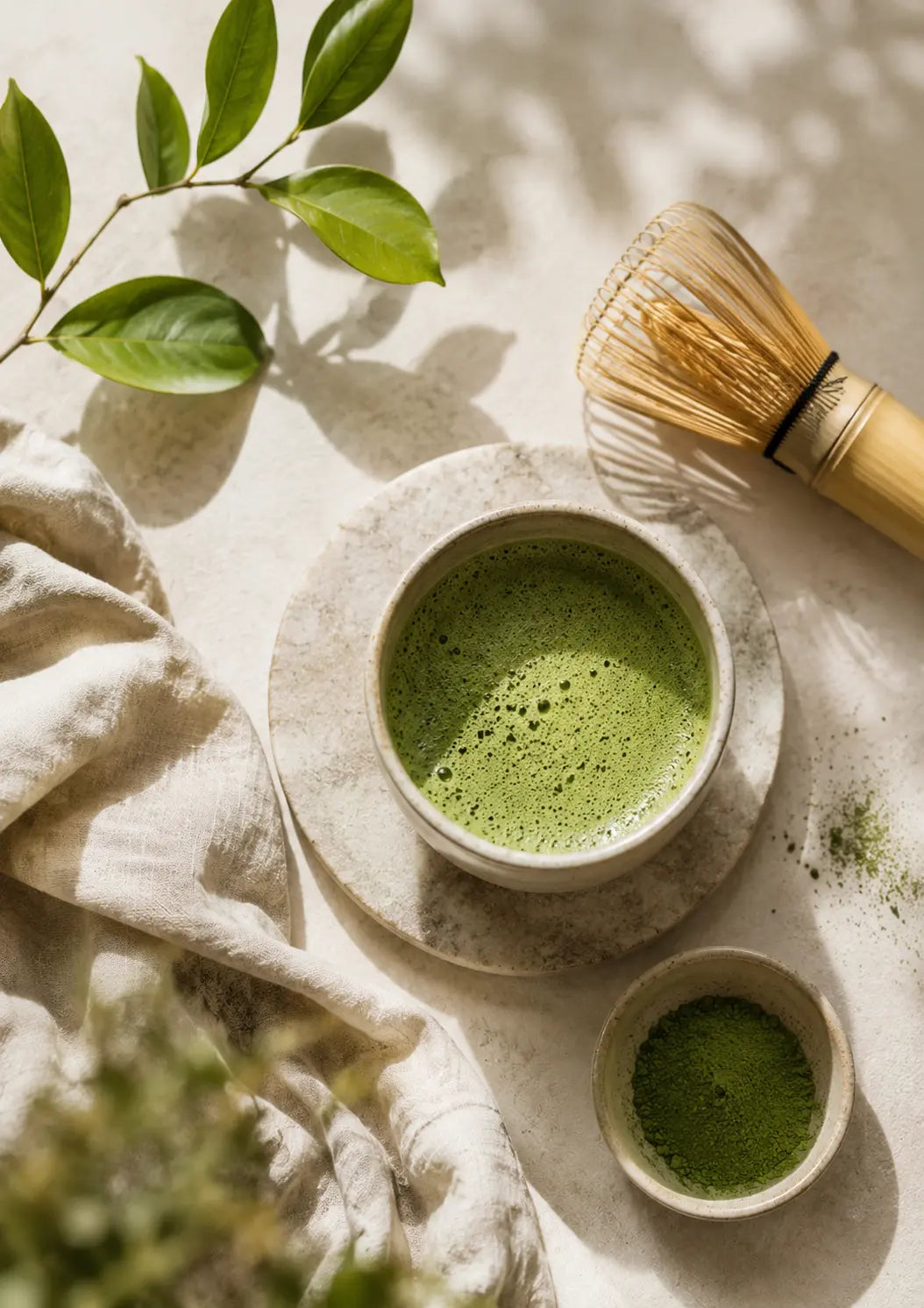
Matcha has a reputation as a superfood — but how much of that is marketing and how much is backed by real science? We dug into the peer-reviewed research to separate fact from hype. Every claim below includes the actual study citation so you can check for yourself.
What Makes Matcha Nutritionally Unique
Unlike regular green tea, where you steep leaves and discard them, matcha is the whole leaf — stone-ground into a fine powder that you consume entirely. This means you're getting the full concentration of the leaf's nutrients, not just what water extracts during steeping.
Studies consistently show that matcha contains 3–10 times more bioactive compounds per serving than steeped green tea, depending on the compound measured [1].
The Key Compounds
EGCG (Epigallocatechin Gallate)
EGCG is the most abundant catechin in matcha and one of the most studied antioxidants in nutrition science. Research suggests EGCG may:
- Support cellular health through antioxidant activity — EGCG scavenges reactive oxygen species and upregulates endogenous antioxidant enzymes [2]
- Support metabolic function — a 2008 randomized controlled trial in the American Journal of Clinical Nutrition found green tea catechins increased fat oxidation during moderate exercise by 17% [3]
- Support cardiovascular health — a 2011 meta-analysis of 14 randomized controlled trials found green tea catechins significantly reduced LDL cholesterol [4]
A single serving of matcha can contain up to 137 times more EGCG than a standard cup of China Green Tips green tea [1].
L-Theanine
L-theanine is an amino acid almost unique to tea plants (Camellia sinensis) — and matcha is one of the richest dietary sources due to the shading process that prevents its conversion into catechins.
Research on L-theanine shows it:
- Promotes alpha brain wave activity — EEG studies show L-theanine significantly increases alpha wave activity within 40 minutes of ingestion, producing a state of relaxed alertness without drowsiness [5]
- Modulates caffeine's effects — a 2008 double-blind, placebo-controlled study found that the combination of L-theanine (97mg) and caffeine (40mg) improved both speed and accuracy on attention-switching tasks, with L-theanine reducing the susceptibility to distracting information during memory tasks [6]
- Supports stress response — a 2019 randomized, placebo-controlled trial published in Nutrients found that 200mg/day L-theanine supplementation significantly reduced stress-related symptoms (measured by PSQI, STAI) and improved cognitive function under stress [7]
Caffeine + L-Theanine Synergy
Matcha naturally contains both caffeine (~60–70mg per 2g serving) and L-theanine (~20–30mg per 2g serving), and research suggests this combination is more effective than either compound alone:
- A 2014 systematic review in Nutrition Reviews analyzed 49 human intervention studies and concluded that the caffeine–L-theanine combination reliably improves attention, with L-theanine mitigating the jitteriness and anxiety sometimes associated with caffeine [8]
- A 2010 study in Nutritional Neuroscience found that 97mg L-theanine + 40mg caffeine improved accuracy during task switching and reduced self-reported tiredness and headache compared to placebo [9]
This is why matcha is often described as providing "calm energy" — the L-theanine smooths out caffeine's stimulant effect for sustained, jitter-free focus.
Caffeine (Natural)
Matcha contains approximately 60–70mg of caffeine per 2g serving (1 tsp) — roughly two-thirds of a cup of coffee. But the experience of matcha caffeine is different:
- Slower absorption due to the fiber content of the whole leaf
- Balanced by L-theanine, which takes the edge off (see above)
- Typically described as "calm energy" rather than the spike-and-crash of coffee
Chlorophyll
The vivid green color of high-quality matcha comes from its chlorophyll content, boosted by the pre-harvest shading process. Shade-grown teas can have up to 10× more chlorophyll than sun-grown teas [10]. While chlorophyll research is still emerging, some studies suggest it may support the body's natural detoxification processes.
Evidence-Backed Benefits
Sustained Focus and Cognitive Performance
A 2017 randomized, placebo-controlled study published in Food Research International found that matcha specifically (not just isolated green tea compounds) improved attention and processing speed in human participants [11]. The researchers attributed this to the synergistic effects of caffeine, L-theanine, and EGCG present together in matcha.
Antioxidant Activity
Matcha's ORAC (Oxygen Radical Absorbance Capacity) score is among the highest of any food — roughly 1,384 units per gram, about 10× higher than blueberries per gram. Research confirms that the catechin concentration in matcha is substantially higher than in regular steeped green tea [1].
Metabolic Support
A 2009 meta-analysis in the International Journal of Obesity reviewed 11 studies and found that green tea catechins with caffeine significantly decreased body weight and helped maintain body weight after a period of weight loss [12]. While matcha alone isn't a weight-loss solution, it can be a meaningful addition to a healthy diet and exercise routine.
Cardiovascular Health
A 2020 meta-analysis in the European Journal of Preventive Cardiology following 100,902 participants found that habitual tea drinkers (≥3 times/week) had a 20% lower risk of heart disease and stroke, and 1.26 years longer life expectancy at age 50, compared to non-habitual tea drinkers [13].
What We're Honest About
We're a matcha company, so we want to be transparent about the limits of the evidence:
- Most studies use green tea extracts or supplements, not matcha specifically — though matcha delivers higher concentrations of the same compounds
- Health benefits come from consistent, long-term consumption as part of a balanced diet — not from drinking one cup
- Individual results vary based on overall diet, genetics, and lifestyle
- Matcha is not medicine and doesn't treat or cure any disease
Quality Matters for Nutrition Too
Not all matcha is nutritionally equal. First-harvest, shade-grown matcha from a reputable source contains significantly more L-theanine, chlorophyll, and amino acids than later-harvest or lower-quality powder. The origin, processing method, and freshness of your matcha directly affect its nutritional profile.
Nippon Matcha is first-harvest, stone-ground ceremonial matcha from Uji, Kyoto — USDA Organic and third-party lab tested for purity. Every tin delivers the full nutritional profile that research associates with matcha's health benefits.
References
- Weiss DJ, Anderton CR. Determination of catechins in matcha green tea by micellar electrokinetic chromatography. J Chromatogr A. 2003;1011(1-2):173-180. DOI: 10.1016/S0021-9673(03)01133-6 — PMID: 14518774
- Singh BN, Shankar S, Srivastava RK. Green tea catechin, epigallocatechin-3-gallate (EGCG): mechanisms, perspectives and clinical applications. Biochem Pharmacol. 2011;82(12):1807-1821. DOI: 10.1016/j.bcp.2011.07.093 — PMID: 21827739
- Venables MC, Hulston CJ, Cox HR, Jeukendrup AE. Green tea extract ingestion, fat oxidation, and glucose tolerance in healthy humans. Am J Clin Nutr. 2008;87(3):778-784. DOI: 10.1093/ajcn/87.3.778 — PMID: 18326618
- Zheng XX, Xu YL, Li SH, Liu XX, Hui R, Huang XH. Green tea intake was associated with lower fasting serum total and LDL cholesterol in adults: a meta-analysis of 14 randomized controlled trials. Am J Clin Nutr. 2011;94(2):601-610. DOI: 10.3945/ajcn.110.010926 — PMID: 21715508
- Nobre AC, Rao A, Owen GN. L-theanine, a natural constituent in tea, and its effect on mental state. Asia Pac J Clin Nutr. 2008;17(Suppl 1):167-168. PMID: 18296328
- Owen GN, Parnell H, De Bruin EA, Rycroft JA. The combined effects of L-theanine and caffeine on cognitive performance and mood. Nutr Neurosci. 2008;11(4):193-198. DOI: 10.1179/147683008X301513 — PMID: 18681988
- Hidese S, Ogawa S, Ota M, et al. Effects of L-theanine administration on stress-related symptoms and cognitive functions in healthy adults: a randomized controlled trial. Nutrients. 2019;11(10):2362. DOI: 10.3390/nu11102362 — PMID: 31623400
- Camfield DA, Stough C, Farber J, et al. Acute effects of tea constituents L-theanine, caffeine, and epigallocatechin gallate on cognitive function and mood: a systematic review and meta-analysis. Nutr Rev. 2014;72(8):507-522. DOI: 10.1111/nure.12120 — PMID: 24946991
- Giesbrecht T, Rycroft JA, Rowson MJ, De Bruin EA. The combination of L-theanine and caffeine may improve cognitive performance and increase subjective alertness. Nutr Neurosci. 2010;13(6):283-290. DOI: 10.1179/147683010X12611460764840 — PMID: 21040626
- Komes D, Horžić D, Belščak A, Ganić KK, Vulić I. Green tea preparation and its influence on the content of bioactive compounds. Food Res Int. 2010;43(1):167-176. DOI: 10.1016/j.foodres.2009.09.022
- Dietz C, Dekker M, Piqueras-Fiszman B. An intervention study on the effect of matcha tea, in drink and snack bar formats, on mood and cognitive performance. Food Res Int. 2017;99(Pt 1):72-83. DOI: 10.1016/j.foodres.2017.05.002 — PMID: 28784536
- Hursel R, Viechtbauer W, Westerterp-Plantenga MS. The effects of green tea on weight loss and weight maintenance: a meta-analysis. Int J Obes (Lond). 2009;33(9):956-961. DOI: 10.1038/ijo.2009.135 — PMID: 19597519
- Wang X, Liu F, Li J, et al. Tea consumption and the risk of atherosclerotic cardiovascular disease and all-cause mortality: The China-PAR project. Eur J Prev Cardiol. 2020;27(18):1956-1963. DOI: 10.1177/2047487319894685 — PMID: 31914813
Fuel Your Focus
First-harvest organic matcha from Uji, Kyoto. Rich in L-theanine, EGCG, and natural caffeine — backed by science. Shop Nippon Matcha →


,%20L-theanine,%20and%20antioxidants%20compared%20to%20regular%20steeped%20green%20tea%20because%20you%20consume%20the%20whole%20...)