Matcha Energy Balls: No-Bake Snack in 10 Minutes
Key Takeaways
- These no-bake energy balls come together in under 10 minutes with just 6 ingredients and a food processor — no oven, no stovetop, no waiting.
- Matcha adds roughly 35–70mg of caffeine and a dose of catechins to an otherwise straightforward snack, turning a sugar lift into something steadier.
- The combination of almond butter and rolled oats provides enough fat and fiber to slow digestion and keep you full for an hour or two.
- Each ball clocks in at about 80–100 calories, making them easy to portion without measuring or counting.
- The recipe is endlessly adaptable — swap nuts, switch sweeteners, add chia seeds, or roll in different coatings to suit your pantry.
Some snacks demand planning. You preheat the oven, measure flour, wait 25 minutes, and wash three bowls before you take a single bite.
These matcha energy balls are the opposite. Six ingredients, one food processor, no heat — ten minutes from start to first bite. They're the kind of snack you make while your coffee brews and eat while you check email.
What makes them worth the (minimal) effort: matcha turns a basic nut-and-date energy ball into something with a gentle caffeine lift and a clean, earthy flavor that cuts through the sweetness. Instead of a sugar spike and a crash, you get a more even pick-me-up — largely thanks to how matcha's L-theanine interacts with its caffeine content [1].
Ingredients
Makes 12–14 balls.
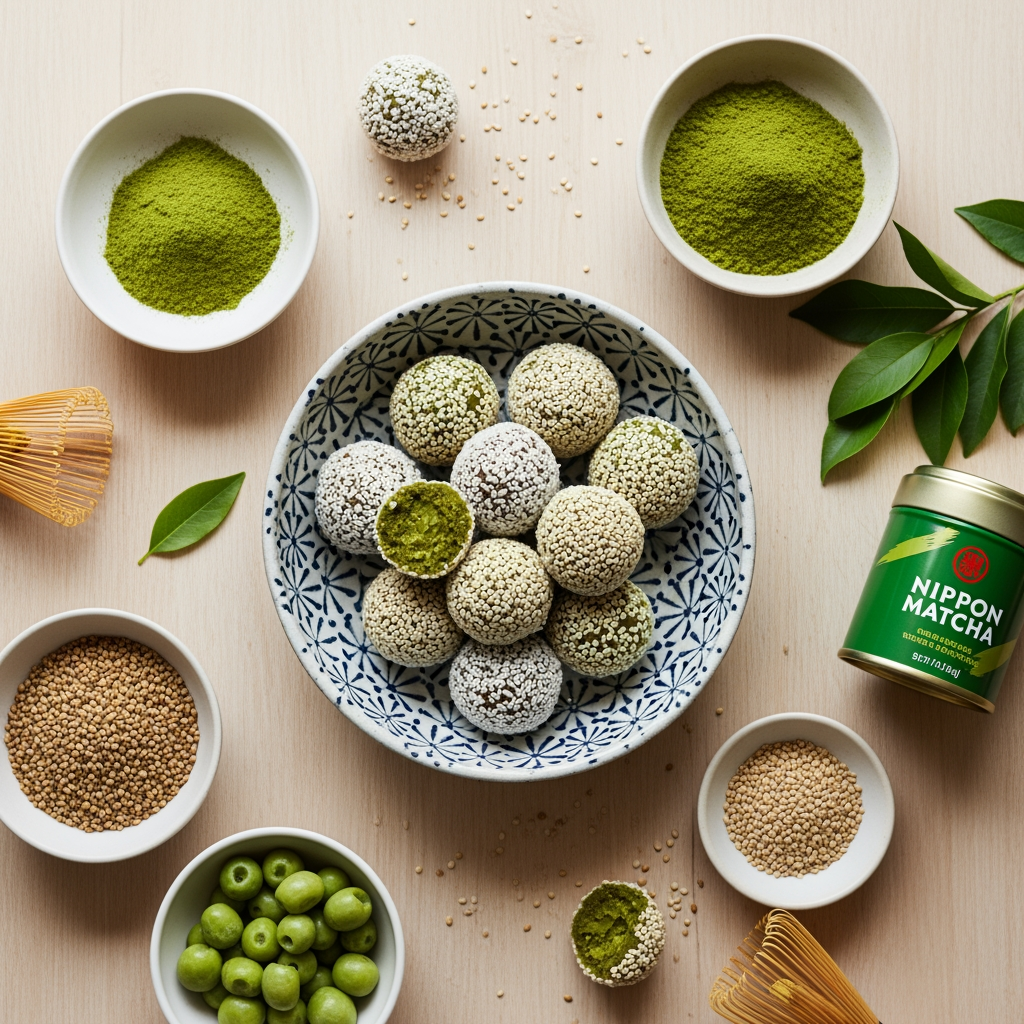
- 1 cup rolled oats
- ½ cup almond butter (or cashew butter)
- ⅓ cup honey or maple syrup
- ¼ cup unsweetened shredded coconut, plus extra for rolling
- 1 tablespoon Nippon Matcha ceremonial-grade matcha powder
- Pinch of sea salt
- Optional coatings: sesame seeds, cocoa powder, crushed pistachios
Instructions
- Sift the matcha through a fine-mesh strainer into a small bowl. Matcha clumps easily when it meets moisture — 30 seconds of sifting now prevents green speckles later.
- Combine everything. Add rolled oats, almond butter, honey, shredded coconut, sifted matcha, and salt to a food processor.
- Pulse until the mixture forms a sticky dough that holds together when pressed between your fingers — about 30–45 seconds. If it's too dry, add a teaspoon of water or extra honey. Too wet? Add a tablespoon of oats and pulse again.
- Roll. Scoop out tablespoon-sized portions and roll between your palms into smooth balls. If the dough sticks to your hands, lightly wet your palms first.
- Coat. Roll each ball in your coating of choice — shredded coconut, sesame seeds, a dusting of cocoa powder, or crushed pistachios for a buttery finish and green-on-green contrast.
- Chill. Refrigerate for at least 10 minutes to firm up. They'll keep in the fridge for a week or in the freezer for up to a month (let frozen ones sit at room temperature for 5 minutes before eating).
Why These Work (Beyond the Recipe)
There's nothing revolutionary about energy balls. Dates, nuts, and oats have anchored no-bake snacks for decades. What makes the matcha version interesting is what it replaces — and how the pieces fit together.
Most quick snacks lean on sugar or simple carbohydrates for energy. That works fast and fades fast. Matcha's caffeine content — roughly 35mg per gram, or about 70mg in a two-teaspoon serving — arrives alongside L-theanine, an amino acid that appears to slow caffeine absorption and smooth out the resulting energy curve [1][2]. The result isn't a jolt. It's more of a sustained hum that builds gradually and fades without the familiar cliff.
The almond butter and oats reinforce this effect. Fat and soluble fiber both slow gastric emptying, meaning the carbohydrate in the oats and honey enters your bloodstream more gradually [3]. What you're left with is a snack that bridges the gap between meals without the rollercoaster — and one that actually tastes like something, thanks to matcha's vegetal, slightly bitter notes balancing the sweetness of honey.
One Matcha Tip
Sift your matcha before it goes anywhere near the food processor. Matcha is a fine, static-prone powder that forms stubborn clumps the moment it touches anything moist — almond butter especially. A 30-second pass through a fine-mesh strainer is the difference between a uniform green dough and one flecked with bitter, unmixed pockets. This applies to smoothies, batters, and lattes too — not just energy balls.
A Few Ways to Make Them Your Own
- Nut-free version: Swap almond butter for tahini. The sesame adds a savory depth that works surprisingly well with matcha.
- Extra fiber: Add a tablespoon of chia seeds or ground flaxseed to the food processor.
- Date-based: Replace the honey with 6–8 pitted Medjool dates (soaked in warm water for 5 minutes to soften). The texture will be denser and the sweetness more caramel-like.
- Protein boost: Add a scoop of vanilla or unflavored protein powder — you may need an extra teaspoon of honey to keep the dough from drying out.
- Chocolate-matcha: Substitute 1 tablespoon of the matcha for 1 tablespoon of cocoa powder for a layered green-and-brown swirl effect. Pulse each color separately, then marble them together before rolling.
If you're looking to try this with proper ceremonial-grade matcha — the kind that blends smoothly without bitterness and carries enough color to turn a beige dough vivid green — our 1.06oz starter tin is a straightforward place to start. It's the same matcha we reach for in our own kitchen for these exact energy balls.
The research above reflects findings from independent clinical trials, not claims about any specific product.
*These statements have not been evaluated by the Food and Drug Administration. This product is not intended to diagnose, treat, cure, or prevent any disease.
References
- Nobre AC, Rao A, Owen GN. L-theanine, a natural constituent in tea, and its effect on mental state. Asia Pacific Journal of Clinical Nutrition. 2008;17 Suppl 1:167-8. PMID: 18296328
- Hidese S, Ogawa S, Ota M, et al. Effects of L-Theanine Administration on Stress-Related Symptoms and Cognitive Functions in Healthy Adults: A Randomized Controlled Trial. Nutrients. 2019;11(10):2362. PMID: 31590748
- Lattimer JM, Haub MD. Effects of dietary fiber and its components on metabolic health. Nutrients. 2010;2(12):1266-1289. PMID: 22254008

Written by Nippon Matcha