How Matcha Is Made: From Shade-Growing to Stone Grinding

Key Takeaways
- Matcha isn't just ground green tea — it comes from tencha, leaves grown under shade for 3–4 weeks, steamed, dried, deveined, and stone-ground into a powder fine enough to suspend in water.
- Shade-growing increases chlorophyll and L-theanine while reducing bitter catechins — this is why matcha has its distinctive vibrant color and umami character, not just its caffeine profile.
- Traditional stone grinding produces 30–40 grams per hour per mill and keeps temperatures low enough to preserve volatile aroma compounds that hotter milling methods can destroy.
- The deveining step (removing stems and leaf veins) is often skipped in lower-grade matcha but makes a measurable difference in smoothness and amino acid concentration.
- Good matcha is defined by its production method, not a label. "Ceremonial grade" has no legal definition — what matters is cultivar, shading duration, stem removal, and grind quality.
Matcha is not simply green tea that has been ground into a powder. That misunderstanding is widespread — and it undersells a production process that is as deliberate as winemaking, with decisions at every stage that directly shape what ends up in your bowl.
The difference between matcha and a bag of pulverized sencha is the difference between a single malt and grain alcohol. Same raw material, radically different path. Here's how that path works.
The Plant: It Starts With the Cultivar
All true tea comes from Camellia sinensis, but not all C. sinensis is equal. Matcha production in Japan relies heavily on specific cultivars bred for shade tolerance. The dominant one is Yabukita, accounting for roughly 75% of Japanese tea cultivation, but premium matcha producers favor cultivars like Samidori, Okumidori, Asahi, and Gokou — all developed specifically for tencha production [1].
These shade-adapted cultivars produce leaves that are thinner, more tender, and higher in amino acids even before shade treatment begins [2]. A plant bred for full-sun harvesting will never produce great matcha — the biology isn't there.
Cultivar choice is the first quality gate. It determines what's possible; the subsequent steps determine how much of that potential is realized.
Shade-Growing: The Step That Defines Matcha
Three to four weeks before harvest, the tea plants are covered. Traditional farmers use kabuse — a canopy of reed screens or synthetic cloth suspended over the rows — that blocks 60–90% of direct sunlight, depending on the target grade.
This isn't about keeping the plants cool. Shade triggers a cascade of biochemical adaptations:
Chlorophyll surges. The plant compensates for reduced light by overproducing chlorophyll. Chen et al. (2022) found that shading at 85% light reduction produced the highest chlorophyll content in matcha leaves, with levels significantly exceeding unshaded controls [2]. This is what gives matcha its electric-green color — it's a stress response.
L-theanine is preserved. Under full sun, L-theanine — the amino acid responsible for matcha's umami and its synergistic effect with caffeine — gets converted into catechins as part of the plant's normal metabolism. Shading slows this conversion. Multiple studies confirm that shaded tea leaves contain measurably more theanine and less epigallocatechin (a bitter catechin) than sun-grown leaves [2][3].
Catechins shift. Not all catechins are created equal. The astringent, bitter ones (like epigallocatechin gallate, EGCG) decrease under shade, while the overall catechin profile becomes less harsh. Kochman et al. (2021) note that this shift in the catechin-to-amino-acid ratio is one of the primary ways shading improves the sensory quality of matcha — less bitterness, more body [1].
The shading duration and intensity vary by producer and target market. Ceremonial-grade matcha typically gets 20–30 days of heavy shade (80–90% reduction). Culinary-grade may get 10–15 days. Less shade means greener economics — faster turnover, lower cost — but also a more astringent, less complex final product.
Shade-growing is not a marketing detail — it is the single most important production variable. It increases chlorophyll and L-theanine, reduces bitter catechins, and sets the ceiling for matcha quality. Everything downstream of this step is about preserving what the shade created.
Harvest: Once a Year, by Hand (If It's Good)
Matcha-grade tencha is harvested once per year, in spring — typically late April through May, depending on the region and cultivar. This is the ichibancha (first flush), and it produces leaves with the highest amino acid content and the most tender texture.
High-grade matcha is still hand-picked. Workers select only the youngest, most tender leaves from the top of the plant — usually the bud and two leaves below it. Machine harvesting is faster and cheaper but introduces more stem material, older leaves, and inconsistent leaf size, all of which degrade the final grind quality and flavor [1].
Once harvested, the clock starts. The leaves begin oxidizing immediately, and oxidation is the enemy of matcha's fresh, vegetal character. Within hours of picking, the leaves must be steamed.
Steaming: Stopping the Clock
Unlike Chinese green teas, which are typically pan-fired, Japanese green teas — and especially matcha — are steamed. The freshly picked leaves pass through a steaming chamber for 15–30 seconds. This brief exposure to high-temperature steam deactivates the oxidation enzymes (primarily polyphenol oxidase) and sets the leaf's color, locking in the bright green that the shade-growing created [1][4].
The steaming time is precise. Too short, and residual enzyme activity leads to browning and off-flavors during storage. Too long, and the leaves become overcooked — losing their fresh, grassy character and developing a muddy or seaweed-like quality.
After steaming, the leaves are cooled rapidly with forced air. At this point, they're still whole leaves — soft, wet, and intensely fragrant. They are now officially aracha (crude tea), on their way to becoming tencha.
Drying: The Multi-Stage Transformation
The steamed leaves enter a series of drying stages that reduce moisture from roughly 75% down to about 5% [1]. This is typically done in a multi-chamber drying oven where the leaves travel on a conveyor through progressively cooler air.
Unlike the rolling process used for most green teas (including sencha and gyokuro), tencha leaves are dried flat, without any rolling or twisting. This is critical: rolling would rupture cell walls and release enzymes and tannins that would oxidize and darken the leaf. By keeping the leaves flat and intact, the drying process preserves both color and chemistry.
At the end of drying, what you have is tencha — flat, brittle, dark green flakes that look nothing like tea but contain everything matcha will become. Tencha has a shelf life of several months when stored cool and dark, which is why matcha can be ground to order rather than sitting as a powder that oxidizes rapidly.
Deveining: The Step Lower Grades Skip
This is where tencha becomes matcha-grade tencha. The dried leaves go through a sorting process that removes stems, leaf veins, and any discolored or imperfect material. In traditional production, this is done by a combination of air separation and hand-sorting.
Why it matters: Xiao et al. (2021) compared leaf-only tencha (LOT) with leaf-and-stem tencha (LST) and found that removing stems significantly improved sensory quality. The leaf-only version had higher levels of total free amino acids, EGCG, caffeine, and chlorophyll, while crude fiber content and the phenol-to-ammonia ratio — associated with astringency — were lower [4].
In plain terms: stems make matcha taste rougher, look duller, and contain less of what you're drinking it for. High-grade producers remove them. Budget producers don't. The price difference is more than branding — there's a quantifiable quality gradient.
Stem removal is not cosmetic. It measurably increases amino acid concentration and reduces astringency — and it's one of the first steps cut when cost takes priority over quality.
Stone Grinding: One Mill, One Hour, 30 Grams
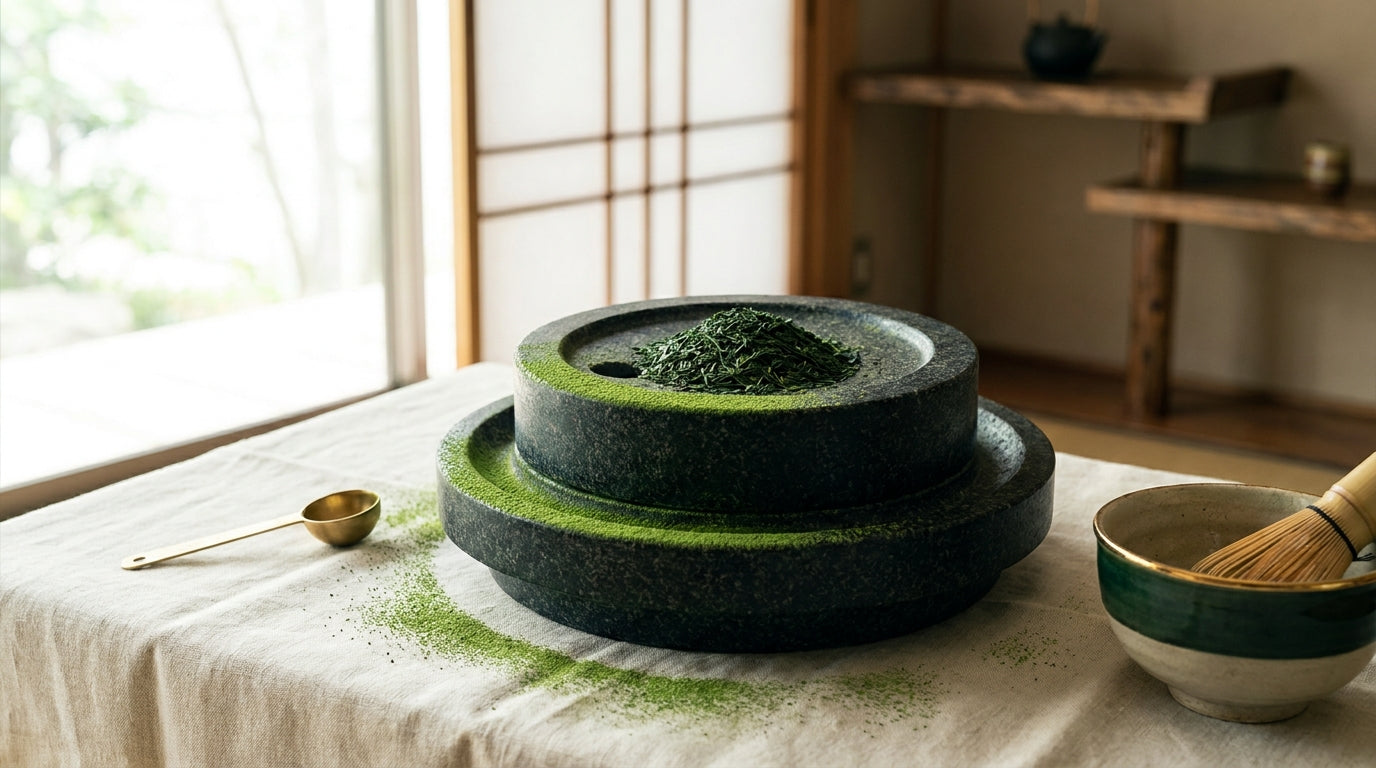
The final step is also the slowest. Tencha flakes are fed into a traditional granite stone mill called an ishi-usu — two circular granite plates, roughly 30–50 cm in diameter, with grooves carved into their grinding surfaces in a spiral pattern.
The bottom stone is fixed. The top stone rotates — slowly. A typical mill turns at roughly 60 RPM, producing 30 to 40 grams of matcha per hour [1]. That's about one tin. Per hour. Per mill.
Why so slow? Because heat is the enemy. Friction from faster grinding raises the temperature of the powder, and even modest heat accelerates oxidation and volatilizes the delicate aroma compounds that define good matcha. Stone is a poor heat conductor, which is the point — it dissipates heat slowly and keeps the grinding temperature below roughly 40°C.
The grooves in the stone are also functional, not decorative. They create a "maze" that gradually breaks down tencha flakes as they travel from the center of the mill outward. The particle size of traditionally stone-ground matcha typically falls in the 5–15 micron range — fine enough that individual particles stay suspended in water rather than settling immediately [1].
For comparison, the average diameter of a human hair is about 70 microns. Matcha particles are an order of magnitude smaller.
Traditional stone grinding is slow, expensive, and irreplaceable for top-tier matcha. The low temperature preserves volatile aromatics, and the granite surface produces consistently fine particles without introducing metallic contaminants. It's also the bottleneck — one mill makes about enough matcha for 30 bowls per hour.
Beyond Stone: Ball Mills and Jet Mills
Stone grinding is the traditional gold standard, but it is not the only method in use today. At industrial scale, matcha is increasingly produced with ball mills (ceramic or steel balls tumbling in a rotating cylinder), jet mills (high-pressure air streams colliding particles against each other), and stirred media mills [5].
Each method has trade-offs. Ball mills are faster and cheaper but generate more heat and can produce less uniform particle sizes. Jet mills keep temperatures low but require enormous energy input and can over-fracture particles, creating excessive fines that clump when whisked. Research suggests that stone milling and certain types of ceramic media milling produce similar particle size distributions, but the sensory differences — particularly in aroma — remain detectable [5].
For everyday drinking, a well-made ball-milled matcha can be perfectly good. For the traditional tea ceremony — chanoyu — stone-ground remains the standard, not out of nostalgia but because no other method reliably preserves the full aroma profile at the same particle size.
How to Spot Well-Made Matcha
Wrapping production knowledge into something practical: what should you look for when buying?
Color. Bright, vibrant green — not yellowish, not olive, not brown. Dull color means either insufficient shading, poor steaming, oxidation during storage, or old powder. The green should look almost artificial in its intensity.
Texture. Should feel like talcum powder or cosmetic-grade dust between your fingers. If it feels gritty, the grind is too coarse or stems were left in.
Aroma. Fresh, grassy, slightly sweet — with a hint of the marine umami that comes from high theanine content. No mustiness, no hay, no stale cardboard.
Origin transparency. A producer that can tell you the cultivar, the shading duration, and the harvest season is signaling that they control — and are proud of — their production process. If the only information on the package is "premium" or "ceremonial," those words are doing the work that the production details should be doing.
Price. Stone-ground, shade-grown, deveined matcha from a named cultivar cannot be cheap. If it's $8 for 100 grams, corners were cut — and you can taste which ones.
Why This Process Matters Beyond the Bowl
The production method is not a curiosity for tea enthusiasts. It determines what you're actually consuming. Shade-grown matcha contains measurably more L-theanine and chlorophyll than sun-grown green tea powder [2][3]. Stone grinding preserves volatile compounds that contribute to aroma and flavor in ways that hotter, faster methods do not [1][5]. Deveining produces a smoother, less astringent cup with higher amino acid concentration [4].
These aren't subjective preferences — they're chemical differences that show up in chromatography. When you pay more for well-made matcha, you're paying for a series of deliberate, slow, quality-preserving decisions at each stage of production. That's either worth it to you or it isn't, but at least now you know what those decisions are.
The research above reflects findings from independent clinical trials and analytical studies, not claims about any specific product.
If you're looking to try matcha that was shade-grown, deveined, and stone-ground in Uji, Kyoto — the region most associated with traditional matcha craftsmanship — our starter tin is a straightforward place to begin. One tin, one cultivar (Okumidori), one harvest, one mill.
*These statements have not been evaluated by the Food and Drug Administration. This product is not intended to diagnose, treat, cure, or prevent any disease.
References
- Kochman J, Jakubczyk K, Antoniewicz J, Mruk H, Janda K. Health Benefits and Chemical Composition of Matcha Green Tea: A Review. Molecules. 2021;26(1):85. DOI: 10.3390/molecules26010085
- Chen X, Ye K, Xu Y, Zhao Y, Zhao D. Effect of Shading on the Morphological, Physiological, and Biochemical Characteristics as Well as the Transcriptome of Matcha Green Tea. International Journal of Molecular Sciences. 2022;23(22):14169. DOI: 10.3390/ijms232214169
- Sano T, Horie H, Matsunaga A, Hirono Y. Effect of shading intensity on morphological and color traits and on chemical components of new tea (Camellia sinensis L.) shoots under direct covering cultivation. Journal of the Science of Food and Agriculture. 2018;98(7):2713-2720. PMID: 29722013
- Xiao J, Cheng Z, Chen Y, et al. Effects of stem removal on physicochemical properties and sensory quality of tencha beverages (Camellia sinensis; Chuanxiaoye). Journal of Food Science. 2021;86(2):420-428. DOI: 10.1111/1750-3841.15571
- Devkota HP, Gaire BP, Hori K, et al. The science of matcha: Bioactive compounds, analytical techniques and biological properties. Trends in Food Science & Technology. 2021;118:735-743. DOI: 10.1016/j.tifs.2021.10.021

Written by Nippon Matcha