
Matcha and Intermittent Fasting: Does It Break a Fast?
Key Takeaways
- Plain matcha (no milk or sweetener) contains virtually zero calories and likely won't break a fast, as fasting protocols are primarily concerned with preventing an insulin spike.
- L-theanine, matcha's signature amino acid, doesn't trigger insulin release — it's purely a nervous system modulator with no metabolic cost.
- The verdict depends on your fasting protocol: strict caloric fasting (zero calories) vs. metabolic fasting (zero insulin-spiking compounds). Most intermittent fasting research is about the latter.
- Adding milk, sweetener, or any other ingredient will break a fast — these trigger insulin responses that interrupt metabolic benefits.
- Caffeine during fasting may enhance fat oxidation, but timing matters: consume matcha outside your eating window to avoid disrupting autophagy during peak fasting hours.
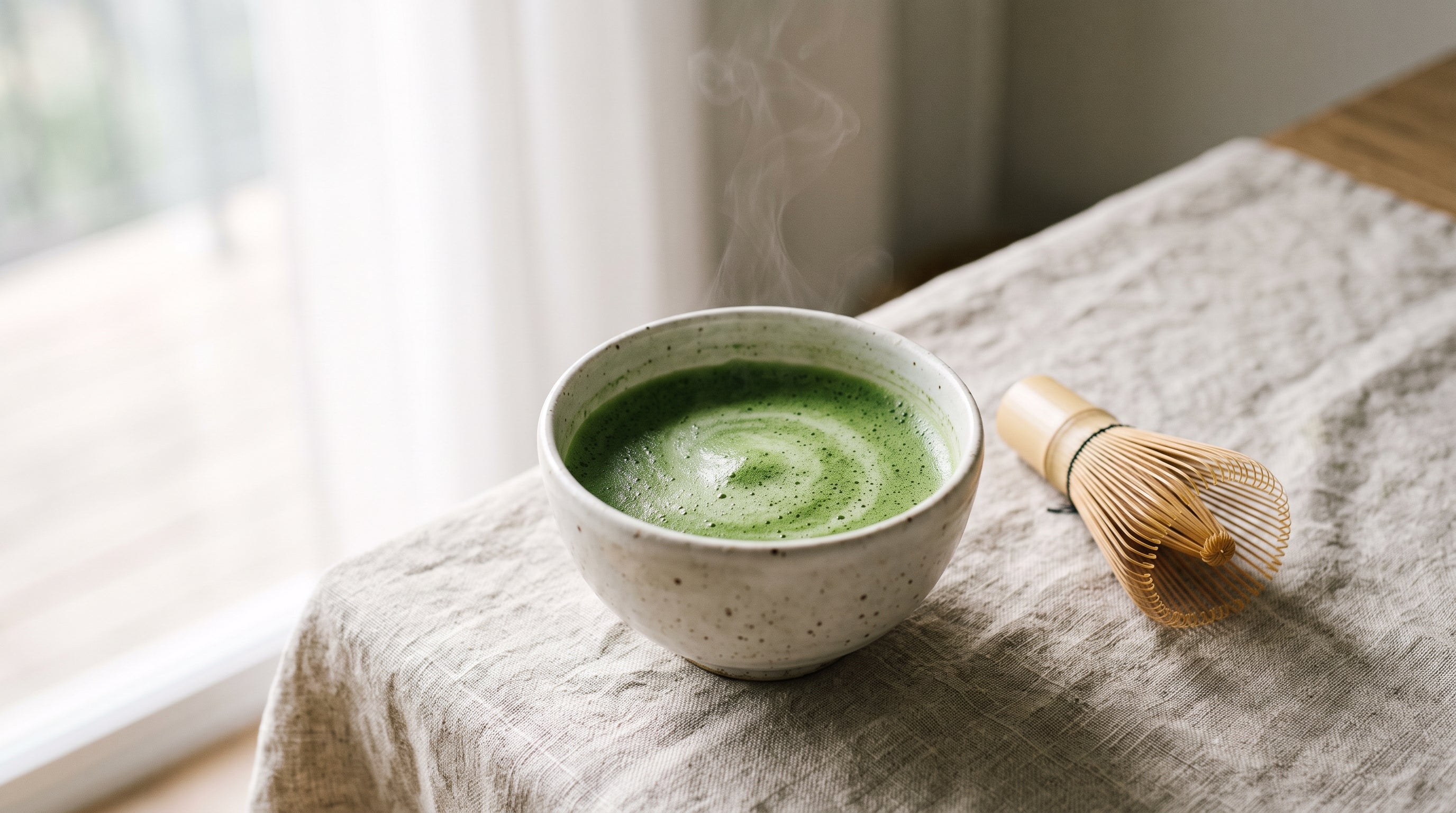
Plain matcha — just powder and water, no additions — almost certainly won't break your fast. It contains roughly 1-2 calories per gram and zero macronutrients that would trigger an insulin response. The question isn't whether matcha has calories (it does, barely). It's whether those negligible calories matter to your particular fasting goal.
What Actually Breaks a Fast?
This is where the confusion starts. There's no single definition of "breaking a fast." Different fasting protocols have different rules.
Caloric fasting
The most literal interpretation: eating or drinking anything with calories stops the fasted state. By this definition, plain matcha—which has 1-2 calories per serving—technically breaks a fast.
Metabolic fasting
The more nuanced approach: a fast is "broken" when you consume something that triggers an insulin spike or disrupts the metabolic processes you're fasting for (like autophagy). Most of the health benefits attributed to intermittent fasting operate here.
Which interpretation matters for you? Research into intermittent fasting benefits focuses almost entirely on metabolic fasting, not caloric fasting. Studies on intermittent fasting examine insulin levels, growth hormone, autophagy, and fat oxidation — not whether you consumed exactly zero calories.
What About Matcha's Caffeine and L-Theanine?
Matcha contains roughly 35mg of caffeine per gram (about 1 teaspoon) and 105-130mg of L-theanine per gram. Neither triggers an insulin spike.
Caffeine during fasting
Caffeine itself doesn't raise insulin levels — in fact, some evidence suggests it may enhance lipolysis (fat breakdown) during fasting states. A 2019 review found that caffeine can increase fat oxidation when consumed in a fasted state, though the effect is modest.
L-Theanine: metabolically inert
L-theanine is an amino acid with a unique property — it doesn't trigger digestive processes or insulin release the way protein does. It works directly on the central nervous system, promoting calm alertness without metabolic cost.
What About "Matcha Lattes" or Matcha With Additions?
Milk breaks a fast
Any milk — dairy, almond, oat, coconut — contains enough macronutrients to trigger an insulin response. A standard matcha latte will definitely break your fast.
Sweetener breaks a fast
Honey, agave, maple syrup, brown sugar — all trigger insulin spikes. To be safe, avoid any sweetener while fasting.
Timing: Does It Matter When You Drink Matcha?
During your fasting window
If you're following a strict protocol: plain matcha is probably fine, but saving it for the very end of your fast or beginning of your eating window is safer. The tiny caloric content won't disrupt your fast metabolically, but it technically breaks a fast in the strictest sense.
The Practical Answer
If you're doing intermittent fasting for metabolic benefits (insulin sensitivity, fat loss, autophagy):
- Plain matcha, consumed anytime during your fasting window, won't break your fast.
- Matcha lattes, sweetened matcha, or any matcha with milk will break your fast — save for eating window.
- If very precise about fasting state, save plain matcha for the last hour or two of your fast.
The 80/20 rule: Drink plain matcha during your fast without worry. The metabolic impact is negligible. If you're adding milk, honey, or sweetener, that's breaking your fast — no debate.
References
[1] de Cabo, R., & Mattson, M. P. (2019). Effects of intermittent fasting on health, aging, and disease. New England Journal of Medicine, 381(26), 2541-2551.
[2] Liu, Z., Zhu, F., Wang, G., et al. (2022). Intermittent fasting increases human skeletal muscle mass and improves glucose metabolism and insulin sensitivity in overweight adults. Obesity, 30(8), 1563-1573.
These statements have not been evaluated by the FDA. This product is not intended to diagnose, treat, cure, or prevent any disease.

Written by Nippon Matcha
%20contains%20virtually%20zero%20calories%20and%20likely%20won't%20break%20a%20fast,%20as%20fasting%20protocols%20are%20primarily%20concerned%20with%20preventing%20an%20insulin%20spike.%0A%0AL...)